29 Jun 2026 /
Insights
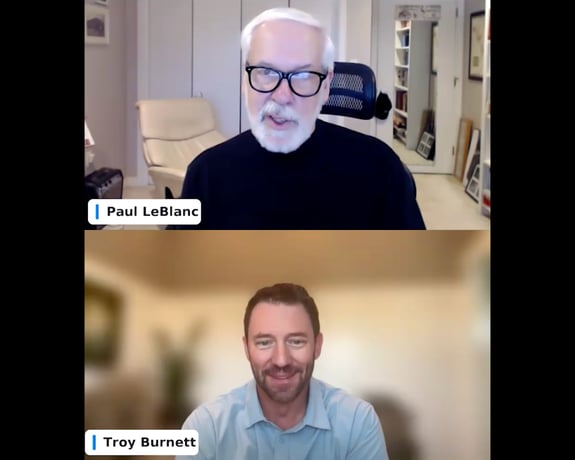
This is Reimagining The Future of Higher Education from Studiosity: conversations with education leaders about their experience in and around the sector, with reflection and evidence for progress.
Guest: Dr Paul LeBlanc, Visiting Scholar and Special Advisor at the Harvard Graduate School of Education; President Emeritus, Southern New Hampshire University (SNHU); former board chair, American Council on Education (ACE)
Host: Troy Burnett, SVP and General Manager, North America, Studiosity
Format: Live webinar conversation, recorded 2026, with a demonstration of Studiosity's Validate workflow
Central question: What does it mean to be an educated person in the age of AI, and how do universities keep learning real when AI can do the work?
Topics: cognitive debt, productive struggle, zone of proximal development, institutional AI policy, assessment integrity, process over product, faculty change management, student wellbeing, friction-maxxing
Key takeaways
- Being educated has not changed in the age of AI; the stakes have. The difficulty of thinking and writing is the point of the exercise, not a flaw to engineer away.
- Learning has two active ingredients: relationship and productive struggle. AI lets students skip the struggle, so institutions must teach students how their own learning works (metacognition) and build tools that scaffold thinking rather than replace it.
- AI has held up a harsh mirror to assessment practices that were already weak. Institutional policy should make assessment relevant, rigorous, and reliable, and shift from grading the product to verifying the process.
- Institutional AI policy should be fixed (institution-wide foundations), flexible (department-level adaptation), and free (left to faculty and students).
- Faculty need training, safe sandboxes, and clear radical commitments. Leaders should figure AI out with their communities, not impose it top-down.
- Students are the heaviest users of AI and its most critical. They report using it while doubting they are learning, and they are seeking out harder, screen-free experiences (friction-maxxing). Technology should strengthen human relationships and cognitive capacity, not displace them.
Episode summary
The danger of cognitive debt
Burnett opens with an MIT study in which students writing with AI assistance showed the weakest neural engagement and could not quote their own work, a phenomenon the researchers called "cognitive debt". LeBlanc's response:
"You can run a 5K race or you can drive the course of a 5K race. Both will get you to the finish line. Only one's going to make you fitter."
Dr Paul LeBlanc
LeBlanc argues that real learning depends on productive struggle: being moved into the next zone of learning without being overwhelmed. Because AI bypasses that struggle, universities must teach students metacognition so they understand that difficulty in writing and problem-solving is the mechanism of learning itself.
A three-tier approach to AI policy: fixed, flexible, free
Rather than blanket bans, LeBlanc recommends a three-tier policy framework:
- Fixed: institution-wide foundations covering data protection, privacy, and ethical use.
- Flexible: department-level guidelines so that different units (financial aid, engineering, and design) adapt AI use to their own context without breaching the foundations.
- Free: pedagogical decisions left to the individual faculty member and their students.
From policing to process: validating learning
LeBlanc says AI has exposed a crisis of assessment that predates it. Higher education must move from grading a final product to evaluating the student's learning process, with tools for observing, auditing, and verifying that the student did the work and owns the thinking, without the "toxic erosion of trust" between students and faculty. In the session, Burnett demonstrated Studiosity's Validate workflow, which is designed to replace AI detection tools and to keep the student in control of their own work:
- establishing a baseline writing profile for each student from early writing samples
- giving formative, AI-driven feedback structured on Bloom's taxonomy to prompt critical thinking without rewriting the student's text
- running a private, pre-submission, viva-style quiz that tests the student's command of their own paper
- letting students fall short privately and revise, so there is no "police and punish" dynamic.
Key terms used in this episode
Cognitive debt: The term used by MIT researchers for the deficit created when a person offloads thinking to AI: the words are produced but the thinking is not done, so the mind borrows against its own future.
Productive struggle: The difficulty that produces learning. LeBlanc calls it one of the two "active ingredients" of learning, alongside relationship.
Zone of proximal development: Vygotsky's concept of the next area of learning a student can reach with support. Push too far beyond it and struggle becomes unproductive and students give up.
Fixed, flexible, free: LeBlanc's three-tier model for institutional AI policy: institution-wide foundations, department-level adaptation, and decisions left to faculty and students.
Relevant, rigorous, reliable: LeBlanc's three tests for assessment policy: is the learning relevant to the student's future, can the assessment be trusted, and does the result transfer beyond the course?
Process over product: Assessing how a student arrived at a piece of work (an audit trail of thinking) rather than only the finished artefact.
Radical commitments: The missions and values an institution declares it will not waver from while everything else changes; LeBlanc cites Brown University's 2026 AI committee report as an example.
Confidence gap: Studiosity's term, from its YouGov student wellbeing research, for students who report using AI tools, including university-sanctioned ones, while doubting they are actually learning.
Friction-maxxing: A Gen Z trend of deliberately choosing activities that are slow, hard, and cannot be done on a screen (sometimes called "granny hobbies"), which LeBlanc reads as a healthy backlash to frictionless technology.
Questions this episode answers
Does using AI to write actually reduce learning?
According to the MIT study discussed in the episode, students who wrote with AI showed the weakest neural engagement and struggled to quote their own essays afterwards. LeBlanc's analogy: driving a 5K course and running it both reach the finish line, but only running makes you fitter.
How should universities set AI policy without banning it?
LeBlanc's framework is fixed, flexible, and free. Fixed rules cover data, privacy, and ethics for the whole institution. Flexible guidelines let each department adapt AI use to its context. Free decisions are left to the individual faculty member and their students.
What makes assessment trustworthy in the age of AI?
LeBlanc says assessment must be relevant, rigorous, and reliable, and should be treated as a tool of learning rather than a tool of judgment. Institutions need to verify the process behind a piece of work, not just the product, with tools for observing, auditing, and verification that do not erode trust between students and faculty.
Is writing still important in higher education?
Yes, with a caveat. LeBlanc says writing remains a principal way of developing and demonstrating thinking, but warns that higher education tends to treat writing as the only proof of intelligence, and that visual literacy is becoming a larger part of how people learn.
How should leaders guide faculty through the transition to AI?
Provide training and support, create safe sandboxes to experiment (LeBlanc cites UC San Diego's "citizen apps"), state the institution's radical commitments, give people grace because the technology is new, and figure it out together rather than top-down.
What is Studiosity's Validate workflow?
As demonstrated by Burnett in the session, Validate replaces AI detection with a process that builds a baseline writing profile for each student, gives formative feedback without rewriting the text, and runs a private, viva-style quiz before submission so the student can show command of their own work and revise privately if they fall short.
Jump to a section of the transcript
- Introduction and the MIT study
- Productive struggle and redesigning how learning happens
- Maintaining public trust through policy
- The value of writing in education
- Radical commitments, faculty training, and the other side of AI
- Student wellbeing and friction-maxxing
- What's next for Dr LeBlanc
Transcript
Lightly edited for clarity. Speaker labels precede each turn.
Introduction and the MIT study
Troy Burnett
We'll go ahead and get started. My name is Troy Burnett. I'm the General Manager for Studiosity, North America. I'm joined by Dr Paul LeBlanc, former ACE board chair and President Emeritus of Southern New Hampshire University. We're here to explore the impact of generative AI on the current landscape: how it's affecting trust and public perception in higher education, how policy is being enacted across campuses, and what is needed to safeguard the inherent value of a degree in an AI-driven world.
I want to begin with my own question, rhetorically: what does it mean to be an educated person in the era of AI? My answer, and what we talk about at Studiosity, is simple. We don't believe that it has changed, but the stakes have.
A quick anecdote. Last year, researchers at MIT asked people to write essays and measured their brain activity. Some used ChatGPT; others relied on their own minds. Those writing unaided showed the strongest neural engagement, and those relying on AI showed the weakest. When the AI group was later asked about what they had written, they struggled even to quote their own work. The words were generated, but they didn't really do the thinking. The researchers called this cognitive debt, which is an interesting term: the mind quietly borrows against the future of its owner.
That gets to the heart of the challenge facing higher education today. What we're going to talk about is how to preserve thinking, and the cognitive friction that produces learning. The essay works because it's hard. That difficulty isn't a flaw to be engineered away; it's the entire point. So how do we preserve it in the age of AI? That's going to drive a lot of our discussion.
Productive struggle and redesigning how learning happens
Troy Burnett
Paul, we hear educators talk about protecting this productive struggle of thinking. How can higher education translate that concept into policy without resorting to blanket AI bans, which we know probably aren't viable?
Dr Paul LeBlanc
Thank you, Troy. It's such an important question right now, and I love the example you began with. I sometimes say:
"You can run a 5K race or you can drive the course of a 5K race. Both will get you to the finish line. Only one's going to make you fitter."
Dr Paul LeBlanc
A lot of students right now are driving the 5K instead of running the course.
As a lifelong educator, I like to use the phrase "active ingredients". Look at the back of a toothpaste tube: it lists all kinds of ingredients, but one is always listed as the active ingredient. You can have everything else, but without the active ingredient it doesn't work. Learning has two active ingredients. The first, which we won't talk about so much here, is relationship. I have a deep conviction that the most transformative learning happens in relationship, usually with a great teacher, but it could be with peers and others. The other, which we are going to talk about, is productive struggle. Vygotsky talked about the zone of proximal development: what is the space that takes you from where you are today to the next zone of learning? If you try to move people too far out of that zone, it becomes unproductive struggle. That's when you give up: I can't do this, I don't understand it, I'll never get it. The sweet spot is that next area: OK, I've got enough, I'm moving into this new space, and so on, and we build out our learning.
So how do we preserve that? First, we need to help students understand how their brains work. We don't talk about this often. Here's a question for anyone listening who teaches: how often do you surface your metacognitive strategy? How often do you say, "We're about to do this exercise. Let me tell you why, and what I'm trying to do"? It's really useful. I'm teaching a graduate class at Harvard later today on redefining learning in the age of AI, and before we start I'll ask them to write down everything they think they know about learning. I'm not even going to look at it. The reason I ask is that I'm going to give them a whole bunch of new ideas, and those ideas will nest in the ideas they already have. I want them to step outside themselves for a moment and understand what those are. These are things we can do.
"Let's start teaching young learners how their brains work, why they need to do certain kinds of things, and how they should use AI."
Dr Paul LeBlanc
We can also build tools that help them do that: tools that scaffold, that help them step out of their learning and understand when they're using AI to drive the 5K versus run it. But beyond the basics, look at the policies that MIT and Brown both released this year. Both had study committees and did deep dives. The MIT one is particularly interesting to me because it says: we've got to rethink learning. We've got to redesign how learning happens.
A concrete example. Kelly Anne Miller teaches an introductory physics class at Harvard, the kind of class everyone at that level has to take. This past year she used an AI platform for all the knowledge transfer, and she had that happen outside the classroom: a flipped classroom on steroids. She was not going to spend class time on it anymore. In class, students worked on real-world projects. They got their hands dirty, worked with their peers, and worked in teams. She enriched the learning, changing the hypotheticals and contexts to see whether they could apply what they'd learned outside class. She reported, and this is a rigorous study with the same curriculum, content, topic, and teacher, a 62% learning gain. That's productive struggle, Troy. I think I understand the material, I might pass an exam on it, but now I have to do it. These are good examples of how we start to rethink our practices and think about learning differently.
Maintaining public trust through policy
Troy Burnett
We're starting to see a lot of institutional AI policy frameworks emerge: AI governance, playbooks, and teaching and learning frameworks. Which foundational elements are most critical? I'd frame it this way: in the absence of policy, it becomes a public trust issue. If we want a university degree to retain its inherent value in the eyes of the public and the workforce, what does that policy framework look like, and what are its most critical elements?
Dr Paul LeBlanc
In the end it's the question of how do you know? In the best of circumstances any institution, any program, even any course, would be very clear about the claims it makes for what students know and can do with what they know. In an AI world, where we have access to enormous amounts of knowledge, it's what we can do with that knowledge that matters. That's a question of assessment and performance.
"Thirty or forty years ago, a college degree was a pretty reliable signal to the labor market that you knew things, that you could comport yourself, that you had good communication and quant skills. That signal has been degraded over time, even before AI. I might argue we had a crisis of assessment before AI. What AI has done is hold up a very harsh mirror to our assessment practices."
Dr Paul LeBlanc
So the policies we need to frame have to be relevant, rigorous, and reliable. Relevant: are students learning what I need them to learn, and is it relevant to the jobs they'll be asked to do and the way they want to be in the world? Rigorous: can I trust this assessment, and how do I know? Reliable: is it transportable? That raises complicated things. Take advanced manufacturing at a community college. Employers hand over their machines so graduates train on the equipment they'll use at work, and studies show the skill transfers reasonably well. But when the lab is set up exactly the way it looks at the employer, retention shoots up, because it's not just the skill, it's the cues around it. I know how this flow goes; I know this moves from here to here. Assessment is complicated.
So we'll be looking a lot more at performance-based assessment. Is there an audit trail? Do we have policies around assessment that make us look at process, not product? It's becoming commonplace to say: stop thinking about product, start thinking about process. Good writing teachers know it was never about the product; it was always about the process. I was a writing teacher at the beginning of my career. When was the last time I saw a piece of undergraduate writing that really knocked my socks off? I'm not sure there ever was one. It wasn't about the quality of the writing. The artifact allowed me to discern and assess the student's thinking, how they got to that writing, their ability to think about audience and tone. We have to be more rigorous and thoughtful about the process by which that happens, and we have to know there's integrity in the work: that the student is doing the work, and is the student we think it is. A lot of this will come down to tools for observing, tools for auditing, tools for verification. And we don't want to be caught up in what's already happening, which is a toxic erosion of trust between students and faculty. Part of what we want to do is really think about assessment, and not the way we have in the past.
"Assessment is a tool of learning versus a tool of judgment."
Dr Paul LeBlanc
When you make assessment a high-stakes judgment, you know what students do? They cheat. They find easy ways out. The research on cheating is very clear: it happens when students feel under pressure, don't have time, and feel like their life, or their GPA, depends on this. We've all known this and wished we were doing it differently.
On policy frameworks: institutions are mostly lagging way behind. Everyone agrees with this, and if you look at the landscape it's happening, but it's happening slowly. I say to university leaders: think about fixed, flexible, and free. Fixed is the policy foundation that applies to everybody in the institution: data protection, privacy, ethical use practices, and so on. Flexible means you don't get to violate the foundation, but you have room. The way your financial aid office thinks about AI will look different from your school of engineering, which will look different from your design school. And free is what you leave to the faculty member and the student. That's what I've been suggesting.
The value of writing in education
Troy Burnett
I'll murder the quote, but I heard something like, "I don't know what I think until I write it down." Working out thought in the process of writing has always been so foundational to education.
Dr Paul LeBlanc
I think the quote is, "I don't know what I think until I see what I've said." And it's true for me: I'm a person who has to write to think. My best thinking happens in the act of writing. To your earlier example, when we simply use AI, it doesn't plant, because we're not actually doing the work we need to do.
Troy Burnett
Do you think writing still plays an important role in education?
Dr Paul LeBlanc
I do, with a caveat. We have long moved away from being a primarily literate culture. Starting in the 80s we moved towards a much more visually oriented culture. Look at how Gen Z learns and watch how much of it happens on YouTube. It's remarkable. In India the studies are clear: it's a complicated place, and in many state schools 25% of public school teachers don't show up on any given day. So India has some of the highest use of YouTube and AI by young people, because that's where they go to learn, and there's remarkable learning on there now. Teachers post physics lectures that are better than what you'd otherwise get. Something like 93% of teachers now use video in their classrooms as a routine part of learning. If you're old enough to remember the early web, it was a lot of text and a little visual, because visuals took up bandwidth. Now any website is all visuals with a little supporting text. Text and writing have become a support for the visual, and our visual vocabulary and literacy are evolving.
I'm a historian of literacy practices; my dissertation research is in this area. We know that cognitive capacities shift. When writing itself was invented, it was a technology, and Socrates railed against it: no one will memorize anymore. Writing is a limited technology. If you say something stupid in writing, it stays stupid; it's always on the page and doesn't get better. But if you and I are in dialogue, we can make each other smarter. Before writing, what you could remember was an incredible cognitive capacity. We're very early in this revolution, and we're going to have to think through much more effectively which cognitive capacities really matter in an age of AI, and which we're willing to let go.
To your question: I think writing will remain incredibly important, because it is a way of thinking, and a way of practicing and honing thinking. I just want to be careful, because those of us in higher education and education generally tend to privilege writing as the way we know someone is smart. There are lots of ways of being smart in the world and expressing intelligence that may not be writing. But writing remains really important, and it's still the principal way the professional and academic worlds develop and demonstrate their thinking.
Troy Burnett
I'll give my perspective from the workforce. As Senior Vice President at Studiosity I've been building a team in the US over the last couple of years. We're a global company based in Sydney, Australia, early in our market journey in North America. As I hire and onboard, I need people who can communicate effectively and think critically. I can't have people who are only good at prompting a chatbot. I depend on my higher education partners, whose graduates I'm hiring, to build those critical thinking and communication skills. We work with academics and do a lot of communicating in our business, so I need to hire really smart people who have developed those skills. It's absolutely critical to the workforce.
Dr Paul LeBlanc
When I look at the platforms and tools now emerging, what we really want is the tools that encourage productive struggle, that scaffold, that help students think rather than doing the thinking for them. Because there is so much attention on this question, you are starting to see tools, including the interesting work you're doing, that are about the learning rather than getting the task done.
Radical commitments, faculty training, and the other side of AI
Troy Burnett
Going back to policy: we have the policy layer and then the faculty layer. What leadership strategies are being put in place, or are required, to guide faculty through this major transition?
Dr Paul LeBlanc
First, there's foundational work every institution has to do today, and that includes support and training. You can't ask faculty to navigate these waters without support, actual use of the tools, and thinking through what it means to teach with AI, assess with AI, where to use it and where not to. To do that you create safe spaces. Some schools are moving out in this way. I think of the University of California, San Diego, a real leader in the space, always innovative, with a tech orientation already. They create ring-fenced sandboxes and invite faculty to bring a problem they'd like to solve with AI. Then they pair them with someone, not quite a forward-deployed engineer, who has been trained to work with them on creating an agent that will do it. They call these citizen apps. Many are never used by anyone but that faculty member, but it gives people familiarity with the tool and a safe space to try things and play. It's not publicly embarrassing if what I made is terrible; that's part of the learning. And they've created clear policy that is forgiving and gives people space. But that's an exception.
"Universities are still really struggling. You see it in the frustration of students who say: I'm encouraged or even required to use AI in a certain way in this class, and over here I get punished for it and brought before the academic policy committee. I just need clarity, and tools that sort me out. Students need the support and the training as well."
Dr Paul LeBlanc
From a leadership perspective, and I talk to a lot of presidents and chancellors, on one level this is change management 101. The fundamentals aren't different. Do you have a clear why? If I'm telling faculty they have to use AI, why? Help me understand. Faculty want to do the right thing by their students. This past May, something like 65% of American faculty felt their graduating students still weren't properly prepared for the workforce in terms of mastery of AI. We've got a lot of work to do. I always say: give yourself some grace. We are very early in this; ChatGPT hasn't been around that long.
Then you need a compelling line. I've always been a fan of the notion of radical commitments. What are you going to reassure people of? Our work is going to look different, the world is looking different, but what are we radically committed to? Of the two recent committee reports, MIT's and Brown's, the Brown one is very much about support, tools, and policies, but it also says: we're not going to waver from what makes Brown Brown. We have missions and values we're radically committed to, and no matter what, those remain the same.
"Think about what your radical commitments are. Then create safe spaces for people to try these things."
Dr Paul LeBlanc
Academia can be unforgiving of mistakes. I've been in it all my career; it's a place where people will remind you 30 years later about the time you tried X and it didn't work. And lastly, if I were leading today, and it's easy for me to say because I'm not leading a university, though I did for a long time, it would be: let's figure this out together. Top-down is not great.
Right now there's a bigger issue for change management and leadership. I've never seen a backlash to a technology as vociferous and fast-rising as what we're seeing with AI, particularly after last week's Hugging Face incidents and the New York Times stories about existential threats to humanity. Look at the data center opposition you see everywhere. I was just in West Virginia, a place that desperately needs jobs, and there are anti-data-center signs on every rural road. Why? Partly concern about environmental impact and electricity costs. But the reality is this new generation of data centers uses less water than the local golf course, and no one complains about the golf course; the next generation will probably be net water positive. A data center is a tangible thing you can point to and oppose in a world that feels scary and changing. So leadership has its hands full, because Gen Z is the biggest user of AI and also hates it the most.
Troy Burnett
That's an interesting tension, isn't it?
Dr Paul LeBlanc
This is a bigger issue than university leadership can handle by itself, but it's also an invitation to say: let's figure this out together and decide, at university X or Y, how we're going to integrate AI on our terms. I argue this in my new book on AI in the university. It's an invitation for universities to reclaim a bigger purpose than job preparation, because AI is asking us to think about what's most important in being human in a world where we've created a kind of alien intelligence. I don't want to overstate that; it's a powerful, revolutionary tool that changes the world. How do we want our sons and daughters, or in my case grandchildren, to be in a world that's going to look very different and probably be volatile for a good stretch of time? Historically, technological revolutions are pretty ugly transitions. There's usually some disaster related to the technology, which is what everyone's afraid of right now. But we always come out the other side into a new golden age. The invitation, in the midst of our anxiety, is to start thinking about what that golden age could look like if we get AI right. We spend a lot of time thinking about how we'll get it wrong, and rightly. But what does it look like if we get it right? It's optimism without being pollyannaish about how hard this is going to be, because I think we're in for another long stretch of hard stuff.
Troy Burnett
If there's a golden age at the end of it, I'll take it.
Dr Paul LeBlanc
And it's our responsibility as universities, in a way no other institution in America or the world is equipped for, to help shape that future. We're the one institution that has the psychologists and the sociologists and the theologians and the technologists and the artists. We have everything needed to have that conversation and imagine what that world looks like. Do you trust the AI companies to make those decisions for you and your children? Do you trust our political class? My answer is an emphatic no in both cases. So where do you turn? This is an invitation for universities to get their mojo back. For lots of understandable reasons we've been in a defensive crouch. We've been under attack. It's a hard time for universities, but it's also a time when the world needs universities more than it ever has.
Student wellbeing and friction-maxxing
Troy Burnett
You mentioned student stress and the tension that's building in a low-trust environment. That's something we measure year over year as a company. We commission YouGov to survey student bodies around the world, and we publish a US-based report that we donate to the sector. We measure student confidence, stress levels, and their perception of their experience, and we've been doing this for about ten years. The shift in the last couple of years has been really interesting. Students are self-reporting that they're using AI, but their confidence that they're actually learning something is low. We call it the confidence gap: I'm using these tools, even ones sanctioned by the university, but I'm not sure I'm actually learning. That has emerged as a big red flag for us to address.
Dr Paul LeBlanc
Students are acutely aware of this. I've been following a phrase you may be familiar with: friction-maxxing.
"Friction-maxxing is particularly true of Gen Z. It's adopting things that are harder to do, that take time, and that can't be done by screen. Sometimes they're called granny hobbies."
Dr Paul LeBlanc
Gen Z is crocheting and quilting and sewing and making bread and building furniture. Movie theater attendance has shot back up to pre-COVID levels, and a lot of that is Gen Z wanting communal physical places rather than sitting in a dark bedroom watching on a screen. It's a healthy backlash. We know this generation of learners has unprecedented levels of anxiety, depression, loneliness, and mental health questions, so your study is incredibly important and timely. And AI is not helping. AI may give us some helpful tools, but the prospect of "will there be jobs for me, will there be a civilization, will our AI overlords come after us" weighs on them. Part of it is connection: students are also saying they feel less connected.
We need to reclaim the classroom as human space. If I had my way there would be no screens in a classroom. I'm a technologist; we use technology in lots of important ways. But I want technology that strengthens human bonds, strengthens relationships, and strengthens cognitive processing and capacity in the way we've been talking about, not technology that displaces. Too often technology is used to displace the human.
What's next for Dr LeBlanc
Troy Burnett
Paul, what's next for you? You're staying busy.
Dr Paul LeBlanc
I'm teaching at Harvard, and helping shape a new AI and education center being stood up at the Graduate School of Education called Compass Collaborative. There's been a soft launch and there'll be a more formal announcement. It's exciting to think about these important questions. We have to give ourselves collectively a little grace, because we're very early in this transition. Higher ed has never won awards for speed and agility, but I think we're moving reasonably quickly given the way we're built. I also have a small, stealthy company building AI solutions and doing good projects, and I spend a lot of time for the Gates Foundation scouting the emerging AI and education landscape. So it's fun to be in conversation with good companies like Studiosity, who've been very thoughtful.
As I listened to you describe and do that demo, I was thinking: if we get this right, we won't displace the human relationship and the role of the faculty member, but we will scale it in ways that have been challenging in an analogue world. As a former writing teacher, whenever I had suspicions about whether something was really the student's writing, all I had to do was sit down with them: tell me about your paper, tell me about your thinking. Make it low stress. You could tell pretty quickly whether someone had command. If you wrote it, you know what's in there; you know the words that are missing. You own the thinking. So tools and solutions like Studiosity's really can help us strengthen the bond between faculty and students.
The other thing is that we often look at solutions in isolation, but they always matter in context. It's not just what you've built; it's the way the faculty member deploys it, the way students receive it and own it, the way they come to use it in practice. When we look at AI solutions we always need to come back to the question: for whom, for what, how, and most importantly, in what context? A solution in one context can be ordinary and in another world-changing. The difference is not the solution. The difference is the user, the purpose, and the implementation in that particular context.
Troy Burnett
Paul, great discussion. I'm so glad you came today. Everyone, check the message board: we've linked to Paul's book, I've put my email in there if you want to reach out with questions, and there's a video of early feedback from students. Happy to take this discussion further with anyone interested. Paul, thanks for joining us.
Dr Paul LeBlanc
Thanks for having me, Troy. It's been a real pleasure.
Reimagining The Future of Higher Education is a Studiosity podcast. This episode is hosted by Troy Burnett. Listen on Apple Podcasts, Spotify, or watch on Vimeo. Read the 2026 US Student Wellbeing Report.