To keep the learning real
Our mission is to increase the life chances of every student in the world.
Because education is the biggest predictor of life chances, and students who use Studiosity do better.
Studiosity is the next generation platform for assessment design and learning assurance in education institutions. Educators use it to develop and then validate the thinking behind every task, that is: support the thinking, validate the learning.
More than 250 universities, colleges, and schools partner with us, across Australia and New Zealand, the United Kingdom and Ireland, Canada, the United States, the Middle East, and Southeast Asia. Students reach the platform only through their own institution's learning management system, never at cost to the student.
We have spent two decades on one idea: a degree should put teaching and learning first. That was true before generative AI. It is now the central question in secondary and higher education - when AI can give all the answers, how can students be empowered to show their thinking?
Our answer rejects detection as a relevant, modern strategy. Studiosity is whole-journey support that builds critical thinking with zero cognitive offload, followed by the student's own self-validation, original thinking attached to every submission.
Studiosity at a glance
Our facts, all in one:
| Category | Assessment design and learning assurance platform for education institutions. |
|---|---|
| What it does | Puts an institution's AI policy into operation on every task; gives students formative feedback while drafting; lets students self-validate their thinking at submission; returns work to educators with that self-validation attached. |
| Evidence base |
Empirical research demonstrates Studiosity's global impact on retention, academic performance, and institutional ROI. A Nous Group (2026) meta-analysis established a 7.3x financial return in retained student revenue across seven partner institutions. Among major institutions, recent research at the University of Toronto (2025) showed 71% of users improved academic integrity adherence, while Georgia State University (2025) recorded an 8.1% DFW rate for users versus 38.9% for non-users. Additionally, QUT (2024) noted an 84% confidence boost alongside retention gains, and the University of Adelaide (2020) confirmed enhanced analytical rigor following an 8% higher course average. Earlier, Curtin University (2019) recorded a 3.96-point CWA increase and 6% higher retention. |
| Institutions partnered | We now partner with more than 250 universities, colleges, and schools worldwide, across Asia Pacific, Southeast Asia, South Asia, the Middle East, North Africa, the United Kingdom, and North America. |
| How students access it | Exclusively through the institution's learning management system, including Blackboard and Canvas integrations. Never sold to individual students. |
| Sector groups we work with | Universities UK, Universities Australia, the American Council on Education, the Chartered Association of Business Schools, and the Higher Education Policy Institute. |
| Governance | A Board of Directors, and an independent Academic Advisory Board of former provosts, vice-chancellors, and senior academics from four continents. |
| Chief Academic Officer | Professor Judyth Sachs, former Deputy Vice-Chancellor and Provost, Macquarie University. |
| Offices | Sydney, London, Dubai, and Salt Lake City. |
| Published policies | AI-for-Learning Policy, Academic Integrity Policy, Privacy Policy, Acceptable Use Policy, Accessibility Statement, and our public Trust Center. |
| Legal entity and patents |
Studiosity Pty Ltd, ABN 41 114 279 668. Validate patent pending: EU 24786404.4, US 19/642,426, AUS 2026202454. |
What learning assurance means
Learning assurance is confidence that a particular student did the thinking, and can now do what their qualification says they can.
It is a claim about what happened in one person's head, not a claim about a document. It is built through the learning process itself - that is, the drafting, the feedback, the questioning, the revision, the new ideas formed, and more human skills owned by the student.
Three things 'learning assurance' is not
| It is not | Because |
|---|---|
| Educational integrity | Integrity policy governs learner conduct: what is permitted, what is misconduct, what follows. It remains necessary. But it responds to the absence of learning; it cannot generate confidence in its presence alone. |
| Detection | Detection makes claims about where text came from. Even when accurate it says nothing at all about capability, and its errors often fall unfairly on the students with the least recourse to contest them. |
|
Surveillance |
Surveillance might watch a document get built, and might say something about the document, but not the learner behind it. Both surveillance and detection use the document as a proxy for learning. |
Hear more from our Chief Academic Officer, Prof Judyth Sachs, about learning assurance
How Studiosity works, in six steps
The same task flow educators and students already use, inside the learning management system, with the policy guesswork and the detective work taken out.
AI policy, live on every task. The institution's own AI policy operationalised on each assessment, so educators aren't guessing what is permitted this semester.Assessment design in educators' hands. Five uses of AI and three validation thresholds, with room for educators to make the call for their own cohort.
Scaffold while drafting. Formative feedback develops critical thinking with zero cognitive offload.
Students self-validate. Viva-style and cloze questions at submission. Students describe it as a relief and as empowering, against the unproductive fear of surveillance and detection.
Submit as usual. The work goes in through the normal flow, now carrying the student's own self-validation and drafting journey.
Assess with confidence. Educators receive the task with evidence of original thinking beside it, rather than a similarity percentage to adjudicate.
Proven
Built on the evidence that matters
Independent and institution-led research, not our own marketing metrics. Every figure is published with its source.
7.3×
Return on investment, as retained students.
Multi-institutional study, The Nous Group, 2026.
5×
More likely to succeed than non-users, on fail-and-withdraw rates.
Georgia State University, 2025.
4–16%
Retention uplift among users of formative feedback support, across seven universities.
Independent analysis, The Nous Group, 2026.
92%
Of feedback interactions rated positively by students.
Brodie, Tisdell, and Sachs, 2019.
Studiosity regularly commissions independent studies from across North America, the United Kingdom, North Africa, SE Asia, South Asia, and the Asia Pacific to pressure test the platform for relevant student and educator outcomes. Read our research.
What students tell us
For ten years we have run an annual global student survey into the wellbeing of students in higher education. The 2026 edition was conducted by YouGov across nine markets with 10,330 respondents, and it is why we build the way we do.
81%
use AI tools for assignments or study tasks. This is the setting all assessment now happens in.
41%
are confident they are actually learning while using general-purpose AI. Students notice the gap between producing work and understanding it.
77%
of AI users report stress about being wrongly flagged by detection tools, more than twice the share worried about being genuinely caught.
2026 Global Student Wellbeing Survey, YouGov for Studiosity (n = 10,330; Australia, Canada, Malaysia, New Zealand, Saudi Arabia, Singapore, United Arab Emirates, United Kingdom, United States).
Three principles, and some of the people who help us set them
These came out of twelve months of recorded conversations with vice-chancellors, presidents, provosts, and chancellors across seven regions.
Zero cognitive offload
Help offered at scale should preserve the cognitive work, not absorb it. Guidance, never answers — and never "write this for me".
Self-validation before suspicion
Students get to show their learning before a grade is final, rather than defend themselves after a flag. The capability is theirs; assurance is the institution recognising it.
Educator in partnership
Assurance depends on educators, so it has to work at full cohort size in week 11 without unpaid hours. Three thousand oral exams is not a plan.
Academic advice:
"The 'detection' landscape is increasingly irrelevant in a post-GPT era. We should be embracing solutions that are rigorous, scalable, and non-punitive."
Professor Rebecca Bunting, Vice-Chancellor and Chief Executive, University of Bedfordshire; Studiosity Academic Advisory Board
"As leaders, our commitment is to the quality of the credential. This multi-layered validation system provides the evidence of learning that educators need to maintain trust in assessment in the era of generative AI."
Dr Noreen Golfman, former Provost, Memorial University; Studiosity Academic Advisory Board
"This platform extension replaces stressful cheating accusations and investigations with a defensible, multi-layered approach to validation. It prioritises authentic student learning."
Professor Judyth Sachs, Chief Academic Officer, Studiosity; former Provost, Macquarie University
Questions people ask about Studiosity
What is Studiosity?
Studiosity is an education technology company whose platform handles assessment design and learning assurance for universities, colleges, and schools. Institutions license it for their whole cohort; students reach it through their own institution's learning management system, at no personal cost.
What is learning assurance?
Learning assurance is confidence that a particular student did the thinking, and can now do what their qualification says they can. It is built through the learning process rather than inspected afterwards, and it is a claim about a person, not about a document.
Is Studiosity an alternative to Turnitin or other AI detection software?
Yes. Where detection asks where a piece of text comes from; Studiosity develops the thinking and then evidences that the student can demonstrate it.
Does Studiosity write or edit students' work?
No. It's zero cognitive offload. Feedback identifies areas to improve and why, and never supplies text to submit, this is what allows the platform to ethically sit inside credit-bearing assessment, and positive student experiences, in institutions.
How does Studiosity use AI?
It's one of the engines, supporting consistent, personalised, zero cognitive offload feedback, and also helps us validate authorship. With Studiosity, our AI and Academic teams are always paired - and our platform and process includes human oversight by default, and its boundaries are published in our AI-for-Learning Policy. In Studiosity, AI never generates work on a student's behalf, and it does not surveil students to produce a suspicion score.
Does this add work for academic staff?
Studiosity is designed to remove a whole 'policing' process from educator workload. Validity is established up front, so the expensive detective work at the end is cut out, and educators receive each task with the student's self-validation already attached.
Who is behind Studiosity?
Studiosity Pty Ltd is governed by a Board of Directors and advised by an independent Academic Advisory Board of former provosts, vice-chancellors, and senior academics. Professor Judyth Sachs, former Provost of Macquarie University, is Chief Academic Officer.
How is student data handled?
Data handling, security posture, and compliance documentation are published in the Studiosity Trust Center, alongside our Privacy Policy and Acceptable Use Policy. Visit the Studiosity Trust Center
How does an institution get started?
Book a conversation and we will map learning assurance to your own assessment strategy, cohort size, and AI policy. Book a conversation
Continuously developing our reconciliation commitments
EDUCATIONAL INTEGRITY PRIZE
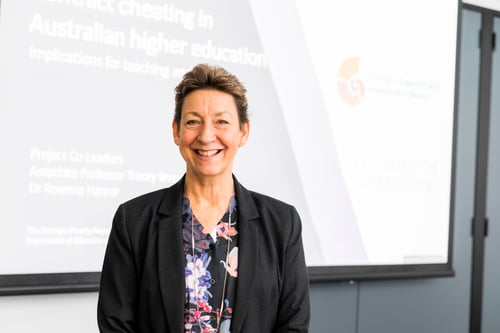
Our ongoing commitment to late researcher and friend, Prof Tracey Bretag, a leading global advocate in educational integrity.
Awards and recognition