31 Aug 2026 /
Insights

Takeout: The question isn't whether the work is real; it's whether the learning is. Here, we discuss how educator feedback, student feedback, and first-hand testing directly shaped Studiosity's Support and Validate experience, ensuring learning assurance isn't about the document alone anymore, and delivering a pedagogically-sound, multi-layered, student-led journey.
Across higher education, confidence in assessment is being reshaped by AI. Students, who are increasingly aware of the risks to their degrees, face significant stress around AI detection. The 2026 Global Wellbeing Study showed that 77% of students worry their original work will be misidentified as machine-generated, and only 41% feel confident they are genuinely learning when using AI tools.
At the same time, educators are stretched thin by academic misconduct workflows, complex tools, and a growing burden of having to find 'proof'.
Studiosity’s newest support and validate service introduces a different approach to assessment validity, where educators choose the assessment design thresholds, and students self-validate their learning at the point of submission.
Throughout the design and development of this service, every major workflow was tested with educators and students, with their feedback directly informing product decisions. Here are some of the most valuable things we learned, and how they shaped the experience.
1. For educators, the right amount of information matters
Educators told us they wanted the information required to make confident decisions. While they value validation data to support their review, overwhelming them with granular analytics adds cognitive load to an already strained grading process.
Insights:
- Workflow fatigue: Escalating potential misconduct through formal channels is time-consuming and when it yields minimal impact. Educators need a reliable 'first-line screening' tool they can trust.
- The right amount of data: Early testing with educators showed that they wanted quick access to additional context - but only when it was needed.
How this shaped the experience:
- Automated dashboard table prioritisation: We streamlined the educator dashboard to default to a clear, high-level summary. Students marked as ‘validation pending’ are automatically surfaced at the top, allowing academics to triage efficiently.
- Quick results view: Based on educator feedback, we prioritised surfacing key context within the dashboard, enabling educators to access supporting information without leaving their workflow.
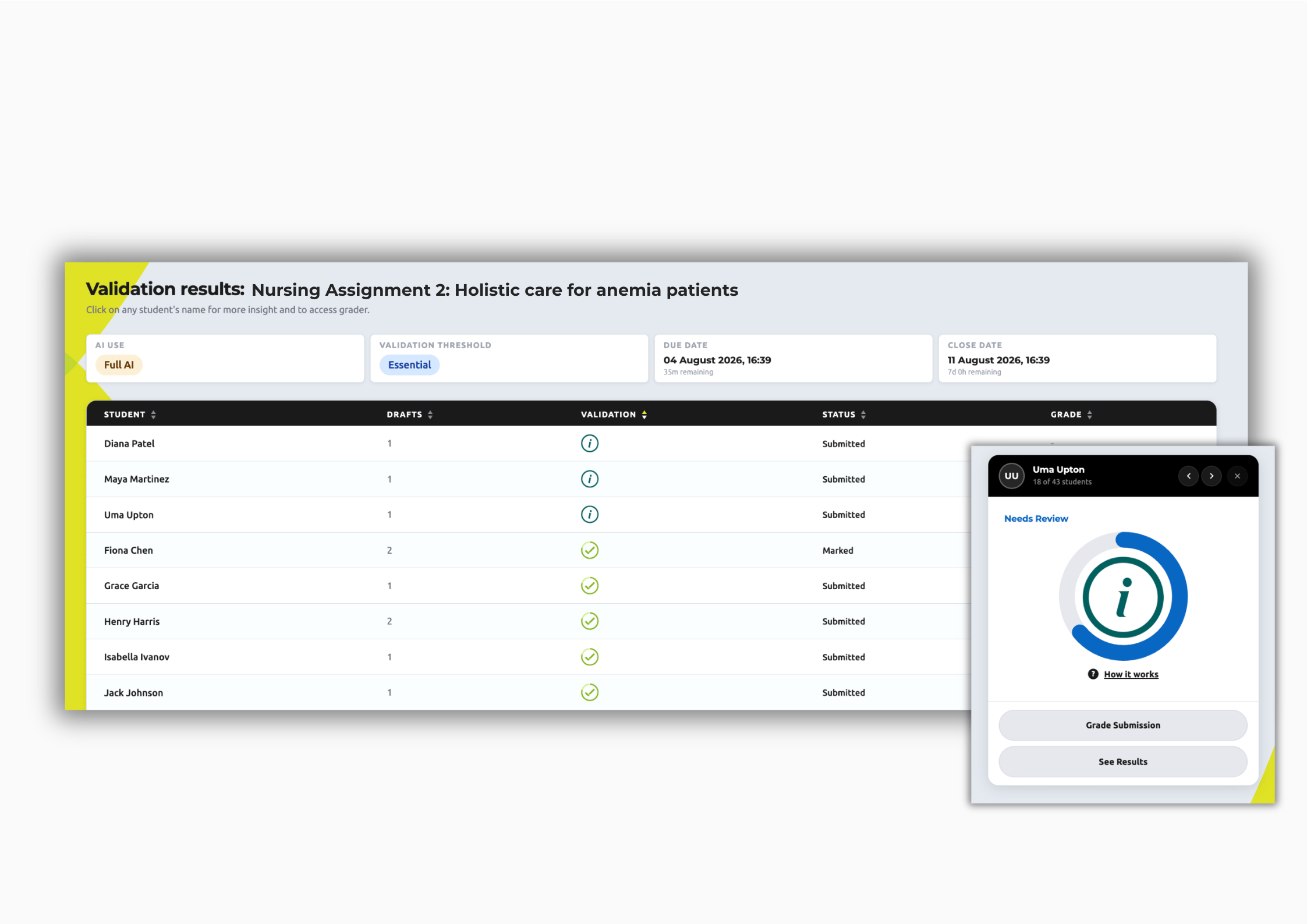 Pending validation results can be filtered, and a quick view box is viewable from this page.
2. Students want to be trusted, not policed
For students, the move toward academic integrity checks can easily feel like they are being watched or tested. Our focus groups revealed a significant shift in mindset once students experienced how self-validating your learning actually works.
Insights:
- A shift to "leveling the playing field": While individual students initially felt anxious about being "caught out," group consensus quickly shifted. Through testing, students shared the sentiment that Studiosity levels the playing field at the point of submission, and gives them a safe way to prove their authorship - without fear of false positive AI detection.
- A desire to showcase their learning: The vast majority of student testers reported they were using AI ethically as a scaffold for brainstorming, planning, and refining structure rather than generating text. Studiosity gave them a tangible way to showcase that genuine learning took place.
“There is this sense of fulfillment I felt from answering the validation questions as well. The validation process made me feel seen. Also the inspiring words that pops up after answering each questions felt like an assurance which made the whole validation process fascinating for me. I was also looking forward to each questions.
The highlight of the whole submission process for me was the choice of questions that I was asked during the validation. I found that really exciting as it coincidentally picked the core of my writing which felt rewarding to me.”
- Student testing participant, Itunu (pictured below)
 One of our student testing participants, Itunu, a PHD student from the UK
How this shaped the experience:
- Understanding the process builds confidence: Students told us the timed questions felt stressful the first time they encountered them. Interestingly, that stress reduced once they understood what to expect. In response, we're introducing a practice question so students can experience the format before beginning the real validation process.
Watch: Why students are calling for self-validation of learning; for a 'win-win' and to overcome a culture of fear in universities
Moving from detection to demonstration
Throughout the testing, the majority of both educators and students agreed on the value of interactive validation questions. Rather than viewing the questions as a hurdle, participants recognised them as a powerful tool to deepen and demonstrate genuine understanding.
For educators, the automated post-submission prompts replace time-consuming manual processes with immediate, meaningful insights into a student’s reasoning.
"It turns an essay writing task into a comprehension task."
- Academic testing participant
“Not only does it help the instructor to know that they actually understand what they're turning in, like they understand the logic behind it, but I would think that just knowing that you're going to have to answer the questions kind of changes the process for them -that there's a little bit more … depth to their writing process knowing that they have to be able to explain it."
- Academic testing participant
For students, knowing they will be asked to demonstrate their learning and process shifts their approach to active ownership of their voice and work, giving them agency to show their work is authentically theirs.
"Overall, the validation process was helpful because it allowed me to explain my work and demonstrate my understanding. It was a little stressful at first, but the questions were relevant and reasonable. More information about what to expect beforehand could make the experience feel less intimidating."
- Student testing participant
Throughout the development of this service, every round of user testing helped shape the experience in practical ways, from simplifying educator decision-making to helping students feel more confident demonstrating their learning.
By designing with people who will be using it, we aim to strengthen modern-day learning assurance, that rests on trust and confidence in teaching and learning.