19 Aug 2026 /
Insights
Takeout: Data from Studiosity users and non-users in universities across Australia, New Zealand, and the United Kingdom shows a 8.8% uplift in student retention and 7.3x return on Studiosity services.
ANALYSIS; NOUS GROUP
What is the impact of Studiosity on institutional retention in 2026?
We asked The Nous Group to find out, again.
7 partner universities | 21,000 Studiosity users
Student dropouts represent both a loss for learners, their families, a loss in lifetime potential and of course, for sustainable institutions, a loss in institutional revenue.
Studiosity engaged Nous to update its landmark 2022 study and evaluate the impact of Studiosity’s critical thinking and formative feedback platform in 2026.
The objective was to independently quantify the relationship between Studiosity and student retention, while establishing a clear ROI metric that weighs retained tuition revenue against subscription and delivery costs.
An Increased ROI and Uplift in Student Retention
Studiosity was associated with improved retention across all seven universities, with impact varying by institution, student cohort, and level of usage.
1. Global ROI of 7.3x
Nous estimates a strong positive financial return, with a weighted average ROI of 7.3, remaining positive across all universities and scenarios, ranging between 1.3 and 16.6. This represents a significant increase from the 4.4x midpoint ROI identified in the 2022 study.
Nous estimates approximately 1,000 additional students were retained from a sample of more than 21,000 Studiosity users.
ROI was highest for universities in the United Kingdom, driven by a larger retention uplift for Studiosity users compared to non-users, and a higher net surplus per student.

2. Average Retention Uplift of 8.8%
All universities in the sample showed higher student retention among Studiosity users than non-users. The size of the uplift differed by institution, ranging from 4% to 16%, reflecting differences in size and composition of the student cohorts, baseline retention and usage patterns.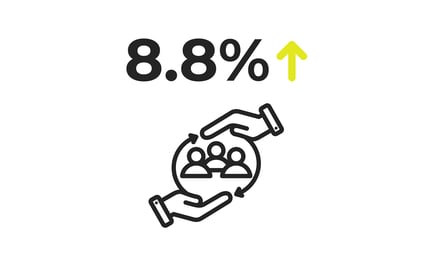
3. Retention Increases with Number of Interactions
Studiosity users with 7+ interactions achieve a significantly higher uplift on average, compared to students with a single interaction, demonstrating the importance of sustained engagement.
.png?width=572&height=335&name=Retention%20uplift%20per%20interaction%20(1).png)
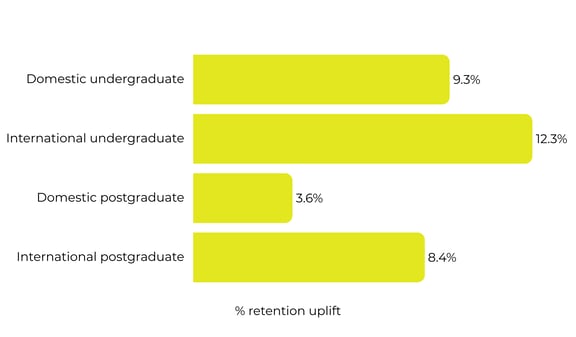
4. International Undergraduates See Highest Impact
While undergraduate student cohorts experienced higher retention uplifts than postgraduates, international undergraduates achieved the largest uplift relative to domestic peers.
Cohort Breakdown and Dataset
The ROI assessment was performed using enrolment and retention data for Studiosity users and non-users from seven partner universities: two in Australia, one in New Zealand, and four in the United Kingdom.
The analysis was based on data from over 21,000 Studiosity users and a control group of over 130,000 non-users, including summary data on enrolment or retention status, domestic or international status, level of study, and study year.
A survey of key stakeholders at partner universities was also conducted to understand differences in Studiosity implementation and rollout, informing key findings of the ROI analysis.
How the ROI was Calculated
Nous assessed the financial impact of Studiosity by pairing university-provided enrolment records with usage data across the seven partner institutions. By tracking retention outcomes for Studiosity users against a control group of non-users, the study quantified the net financial value generated by retained students relative to the institutional cost of the Studiosity services.
Note: The study applies a conservative 50% attribution factor to reflect that Studiosity is one of several drivers of retention. A low-medium-high bound approach was used to account for the complexity and lack of industrial consensus on calculating the exact marginal cost for an additional student.
About Nous
Nous Group is an international management consultancy operating across Australasia, the United Kingdom, and North America. Working with public, private, and community sector organisations, Nous specialises in strategy, digital transformation, and economic analysis to address complex policy and organisational challenges.
Download the Full Report
Discover how Studiosity can support student success while delivering measurable financial sustainability for your institution.