01 Apr 2026 /
Insights
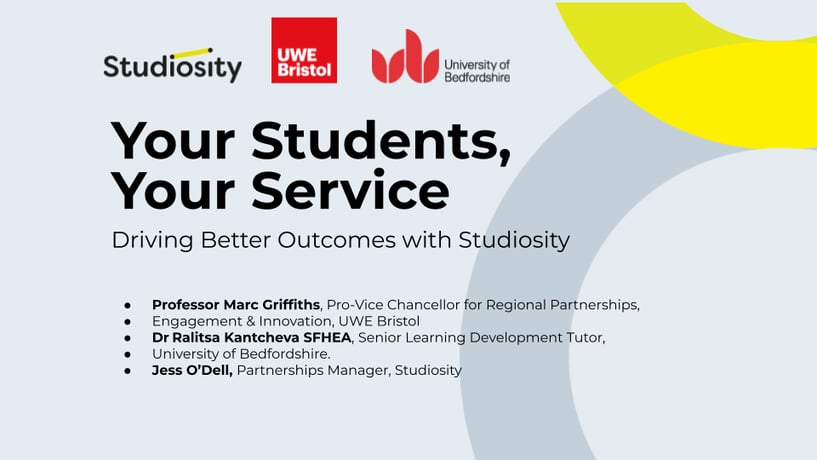
Transcript: Your Students, Your Service - Driving Better Outcomes with Studiosity
26:52
In our recent webinar, Jessica O'Dell showcased how Studiosity’s pedagogy-first AI supports students and educators in higher education. Joined by Professor Marc Griffiths (UWE Bristol) and featuring insights from Dr Ralitsa Kantcheva (University of Bedfordshire), the session explored ethical and responsible AI use, practical strategies for embedding support, and evidence showing how repeated engagement boosts retention and closes attainment gaps. Attendees gained actionable tips for helping students build confidence and skills while accessing real-time feedback, and learned how AI-generated insights can inform teaching and enhance student outcomes across all levels of study.
The goal of this session is to help you and all staff get the most out of your institution's Studiosity service. You will learn how to support students equally and at scale with concrete actions and ready-to-use resources.
- Professor Marc Griffiths, Pro-Vice Chancellor for Regional Partnerships, Engagement & Innovation, UWE Bristol
- Dr Ralitsa Kantcheva SFHEA, Senior Learning Development Tutor, University of Bedfordshire.
- Jessica O’Dell, Partnerships Manager, Studiosity
Jessica O'Dell:
Hello everyone, thanks for joining today. Today's session is designed to show how Studiosity's pedagogy-first AI can be used responsibly, ethically and in support of both educators and students. Here with us today is Professor Marc Griffiths, Pro Vice-Chancellor for Regional Partnerships, Engagement and Innovation at UWE Bristol.
Unfortunately, Dr Ralitsa Kantcheva (Rally) from University of Bedfordshire was unable to join us in the end but has kindly recorded a fantastic segment for us to include. A quick note on housekeeping, it's a short session and we want to share with you as much valuable information as possible, so please do feel free to drop some questions into the chat, especially for Marc whilst we have him here, and if we can't get to them at the end of the session we'll follow up on these and share the recording and the resources with you at the end. So what we're looking at today, four topics, we want to show you a quick look at some key research data points telling us why a pedagogy-first AI approach is crucial to support learning, gain and protect degree value.
From Marc, the leadership perspective on how Studiocity fits in with the wider core values of AI policy and use at UWE Bristol. From Rally, a video that you can watch later with insights into her extremely hands-on day-to-day management of the Studiosity service at the University of Bedfordshire. And then finally back to me where I'll give you some very practical advice as to what you can do starting today to ensure you and your students benefit from your Studiosity service. So what does the data tell us and why is this important? Based on our 2026 UK Student Wellbeing survey carried out in partnership with YouGov, we know that university students are using generic AI tools more and more, a 7% increase on last year's reported usage, but it's stressing them out. 60% of students experience some levels of stress when using AI tools and by that we can assume generic and possibly non-university approved tools. And why are they stressed? Because the fear of being accused of cheating when in fact they did nothing wrong.
"University students are using generic AI tools more and more, a 7% increase on last year's reported usage, but it's stressing them out. 60% of students experience some levels of stress when using AI tools...And why are they stressed? Because the fear of being accused of cheating when in fact they did nothing wrong. "
Over half of all students surveyed listed this in their top three stressors. So as well as the educators on this webinar, we know that all students are also worried about their diminishing critical thinking and communication skills. This is coming from their over-reliance on these generic tools which were not built to be fit for purpose for educational purposes and come without the clear and ethical guardrails that students and university staff need.
However, students, a vast majority of them, do feel that it is possible to gain knowledge whilst using AI tools. So let's remove that stress and make sure they're using the right tools. These are just some of the key findings from the recent independent research by Dr Rebecca Mace on the 'Ethical use of AI for Boosting Learning Retention and Progression.' She found that high users of Studiocity saw a 95% increase in retention compared to 82.8% for low users. Lower performing students improved the quickest when using Studiosity. It's helping to close those attainment gaps.
And the optimum number of interactions with Studiosity support to deliver this impact was six, which is why we advocate for repeated use until students feel confident in their skill development. So that's briefly covered the reasons why and now Marc's going to share his thoughts on why it was important for UWE Bristol as a whole institute to adopt and deeply integrate Studiosity as a pedagogy first AI learning tool. Over to you Marc.
"High users of Studiocity saw a 95% increase in retention compared to 82.8% for low users. Lower performing students improved the quickest when using Studiosity. It's helping to close those attainment gaps. "
Professor Marc Griffiths:
Thank you very much Jess and hello and it's lovely to see people online this afternoon here. As introduced my name is Marc Griffiths, I work at UWE Bristol and I work with some amazing colleagues at the University who really have considered and thought about how we implement the Studiosity kind of suite of products really for our students and staff as part of their progression and their learning journey as Jess has outlined. And I just want to start by just saying the facts that Jess presented there around Dr Mace's work really does kind of give the kind of the position of where the potential impact is for students who may engage with a suite of products that Studiocity offers in terms of the checking of their assignments, the assessments and that critical feedback that comes with it as well and the importance of frequency of use, particularly for those students where if they're working part-time, they are working their other commitments, it's that out of hours support that we often talk about.
So look from a leadership perspective, we've tried to kind of approach the use of Gen AI or AI through a dual lens if you like, making sure we've got decent robust governance in one kind of aspect whilst also embracing technology and innovation and practical use. Jess mentioned a little bit earlier about some of the fear, some of the concerns that students have and typically a lot of our students are concerned about whether using any form of AI is going to get them into trouble or actually kind of expose them in terms of it not being their work. That's so far removed from where we need to position this particular technology in terms of further enhancing the critical skills.
We're also cognisant here at UWE Bristol as are many other higher education institutes of the need to position the wider support and guidance for students, recognising that diversity within student groups is increasing and that's fantastic because it shows the representation and the strides across society but also we have increasing commuter students who are commuting into and from organisations and universities in particular as well. On the policy side, we've tried to be really careful and considered and this has taken some time I have to say in terms of how we think about the ethical, the transparency and the equitable guidance required for any form of AI that's being used and you'd like to think that this would be the most pressing within the learning and teaching space and the pedagogy space and you'd be right but also if you think about research and about the ethical implications of research for example, they do spill over into those quarters as well. Making sure that we align with best sector practise and frameworks, I was lucky enough to be involved in a piece of work working with the Council of Deans of Health for example, looking at emerging AI principles if you like within the field, particularly where you've got professional statutory and kind of suitability responsibilities as well.
These are major concerns so you have to think about this in terms of how you're embedding this across programmes such as healthcare for example or law as two examples. What I will say though is that a pedagogy first approach to Gen AI is absolutely the right way around to be doing this. There's no point in having these tools if it's not scaffolded around the wider holistic support for students and embedded as part of the inductions, embedded as part of the onboarding of new students and returning students as well to diversity.
I've mentioned to Jess a couple of times that my own daughter is actually studying at university and she's used Studiosity a few times as part of her assessments and it's really opened her eyes I think in terms of what it means to have this critical feedback which is done in a in a way that may not be traditional but it is actually about how you get acceptance in terms of having that repeat exposure to having critical feedback on your work and guess what that reflects real working life doesn't it as well. So I've talked about the scaffolding, I've talked about the need for making sure that when we actually have these AI tools supporting it's important that we think about well what are we using them for, is it for the assessment, is it for the evaluation of skills, new knowledge, is it about thinking about how we use these platforms during normal working hours, outside normal working hours and the demographic of our students as well. Engagement aided this academic year by embedding access through links such as Blackboard which is a VLE that many universities use has increased our overall usage. We've increased it significantly and the actual positive feedback that we've had from our students roughly just under 83 percent of all our students give a really positive satisfaction for our Studiosity suite with for the Writing Feedback Plus tool in particular 91 percent said they felt more confident when using it post survey that we did. The average return time and I can't believe I'm saying this because it's actually phenomenal when you think about it just under two minutes so 1 minute 47 for a return on when someone submits their assignment and then they get back the high quality indicies coloured feedback on their work for them to actually then push on and there's nothing stopping them again from repeating that process."
"We've increased it significantly and the actual positive feedback that we've had from our students roughly just under 83 percent of all our students give a really positive satisfaction for our Studiosity suite with for the Writing Feedback Plus tool in particular 91 percent said they felt more confident when using it post survey that we did. "
I think that's really powerful and in terms of how you then wrap that around the wider personal tutoring support, the opportunity for them to meet with their personal tutor, their wider group peers, their wider group of staff as well on the programme, I think you then start to get this what I mentioned earlier this really holistic and scaffolded approach.
Creating that right environment is really important for students and staff and we have make sure there's clear communications in place. I mentioned the need for robust peer support, personal tutoring and also how the institution where Studiosity may be used is actually approaching the call to action, as I call it sometimes, the call to action for all students whether it's through the briefings, as I mentioned the inductions, the onboarding, part of the even application process to a university, how it's spoken about on open days, being really overt. So when we talk about having a leadership approach and the architecture of how we design this, so it's embedded from pre-day one for the learners and for the parents, the mums, the dads and the guardians who might be accompanying their particular learner on their journey as well.
This is with us, Gen AI is with us, whether we like it or not, what we are accountable for and I firmly believe this, this is about making sure we put the right ethical steps in place to make sure that when any form of AI is being used across learning, teaching, research, innovation, it's done with the values driven approach and I firmly believe that students who can access a platform such as the Studiosity platform, where they can upload and pretty much on their terms, in terms of how they do this, 24 hours a day, I think that can be only thing but a positive and more flexible way of doing it as well. I want to talk a little bit as well about policies, I know it doesn't float everyone's boat but I think you need to have policies in place that then recognise that in this fast-paced moving times, technology and how you embed it is really, really important and that's where the development of new ways of working, making sure that you're engaging with the staff council to get their feedback and student councils as well to get their feedback and how that plays back then into the future design of curricular assessments as well.
You know, there's some really massive opportunities here to really reflect upon assessment design, make that really contemporary, solving real-world challenges.
I think this is where universities really need to be gearing towards and actually Gen-AI tools and tools such as software platforms such as Studiosity give us the ability then to actually to offer those critical feedback loops if you like as well. A couple more bits for me before I kind of finish really. Making sure safe spaces are created where things can be tested is paramount.
Students feel best or they feel trusted or they feel a sense of trust when they can go and try things. They can try things without a kind of risk of being labelled or fear of being blamed or fear of being caught out. You know, the plagiarism word is a terrible word and students, believe it or not, actually want a place where they can test stuff and see for themselves what it means what it means to have this constructed broken down feedback for them as well.
So these safe spaces are really important. It's also about making sure we embed AI literacy into our digital skills offering, what that means for staff and how you support staff within your organisation. And for many universities that are very practise-orientated such as UWE Bristol, it's also about how we can use these tools to actually further develop students who then become some of them our future staff, some of them our future researchers and they complete that full loop as well.
So look, overall the balance comes from framing AI not as a threat. It's about making sure we have it as an enhancement tool whose value depends upon being informed for critical use and building trust between users. I really believe that, I really do.
And I think our approach here, for what it's worth, has been around trying to encourage experimentation with clear guardrails, laying out the foundations for inclusive design mindsets, being future focused while protecting academic standards and rigour, reputation and student outcomes. So whether that's with the Office for Students, Ofsted or the professional regulatory bodies, promoting a culture of holistic learner-centric approach to support, using a wide range of tools and approaches which is crucial to helping students progress, but also retaining our students to have successful outcomes. I think that's probably me done, Jess, really, in terms of how I want to kind of get those points across.
"I think you need to have policies in place that then recognise that in this fast-paced moving times, technology and how you embed it is really, really important and that's where the development of new ways of working, making sure that you're engaging with the staff council to get their feedback and student councils as well to get their feedback and how that plays back then into the future design of curricular assessments as well."
Jessica O'Dell:
Thank you. That's great. Thank you, Marc. So formative learning and development of each student's academic writing ability. It's meeting them wherever they are at and boosting their confidence and their attainment. So all of this is also providing actionable insights for educators.
And again, supporting students when they need it most. So with more higher education students than ever juggling part time work or caring responsibilities as well as study, having this equitable access to help within a matter of minutes, which is available 24 hours a day, 365 days a year is invaluable, which is adding this extra layer of support, which is a complement to that which the university is also offering. And the high level of student satisfaction.
So this is consistently extremely high at UWE, along with lots of other partners. And with the engagement data and feedback that comes from the Studiosity use is providing this very valuable insights at an institutional level into the student support seeking behaviour and needs. We actually did a recent pilot programme where we showed that 86% of the students using Studiosity were not using any of the other support mechanisms at that particular university.
So it really shows that we're able to reach students that aren't using other support mechanisms. Now, Rally from Bedfordshire has unfortunately unable to join today, kindly recorded this video and the accompanying slides, which I really encourage you to watch when we send this through after the event. We didn't want to take up the time today when we have Marc here and obviously you all on the call, but it will be seven minutes really well spent.
She's included some really hands on advice for embedding Studiosity in teaching and support. So a huge thanks to Rally for sharing her experience. I'm really confident there's stuff in there that we can all learn from and implement.
So please do delve in there. She goes into really great detail as to sort of how she's activating this across Bedfordshire with all the teaching and support staff and how they're using it to evaluate and feed that back into the support system. So technology aside, in simple terms, these are the outcomes that we are working really closely with all our university partners around the globe to achieve.
So one, to provide students with trusted and immediate writing feedback and study support right in the moment when they need it the most. Two, to enable students to think for themselves and improve their own work. So building confidence and skill. And three, to empower educators with valuable and actionable data and insights which is specific to their students.
So in a global study of student preferences for university communication, this was completed with the Behavioural Architects in 2023, students wanted their teacher to make it a task, to be explicit with three clear steps, or to show them the task at the start of a lecture or a tutorial session. You will hear the rest of the Studiosity team and I talk about this all the time. The simplest way to get students actively using their support is to give them a task.
So direct them to log into Studiosity to submit a piece of their written work and see what feedback they get. Most educators tell their students via their own preferred channels, so it could be an email, a unit or course notice board, in-class workshop via the pop-up announcements and digital screens in the library. So lots and lots of different modes that you can use to sort of just reinforce that messaging with students.
These are some of the resources that you'll receive right after the webinar. We'll finesse our recording a little bit and send those through to you. So lots of you will already have received this through your Studiosity account manager at the university.
The engagement toolkit has loads of downloadable resources that you can use, some click and share messaging. So all of this is designed to make it as easy as possible for staff and students to effectively use Studiosity and to start seeing that positive impact straight away.
This is a quick example, so it's a quite an extreme anonymised but real example from two of our Australian university partners, just showing the difference in student reach when clear direction is given by teaching and support staff. So when students at University A were left to their own devices, only 10% of them were actively using their Studiosity support, so it wasn't really making the most of it as a university. When University B proactively directed all their students to Studiosity and underpinned that with activity, as UWE Bristol has been doing, sort of embedding it in pedagogy and with really clear messaging, they reached 82% of their students.
So you can imagine how much more significant the impact was for them and their students, not to mention the return on investment for that university when it came to student satisfaction, attainment and retention. So needless to say, University A is changing their strategy and we hope to see their percentages growing quite rapidly. So it just sort of shows the real difference and that importance of that messaging and that reinforcement from educators.
So to wrap things up, we'll have a little delve in for a second and see if there's any questions that Marc and I can answer for you. As we said, we will follow up with those resources, please make sure to watch Rally's video segment, reach out to us at Studiosity with any questions you have, either myself or Ellen, your sort of partnership managers. There are tonnes of resources on our website, there's case studies, research matrix, please take a look at those.
And to leave you with three really, really easy actions that you can do and act on today, there's an interactive writing feedback demo that you can use to see what your students see when they submit their work for feedback. So you can actually work through all those steps very easily. Direct your students to create their secure Studiosity account.
They access it from within your own LMS, it's really, really secure, it's very easy for them to use. So please, any that haven't already created their accounts, get them to do that. And just tell them to submit a previous piece of work.
So it's a really low stake exercise, so 500 words or more is ideal to get the real breadth of feedback. And they can just see, you know, what feedback they get within a couple of minutes. Once they see how easy and quick that is to do, we're confident that they'll be using it more and more.
So we'll just jump in and see if we have any questions we can answer in the moment. But thank you very much to everyone who's joined.
"Evidence tells us that students need clear instructions and guardrails. This is backed up by analysis of over 2.2 million students who are already seeking support via their Studiocity accounts. "
Professor Marc Griffiths:
And also student reps as well, they're really important, and student advocates as well. So by trying to build a kind of bit of a groundswell, a bit of a movement, that's probably the best way that we can get encouragement. Also, there's nothing better, is it, than a student saying to you, wow, I never thought I would have got 68%, 71%.
I'm so glad that I used something to give me some critical feedback. And that, again, I'll stress, this is not replacing, this is about using it in conjunction with the wonderful staff, the wonderful personal tutors, that those staff, those students would be accessing as well. It's just that extra dimension that really helps.
Jessica O'Dell:
Yeah, absolutely. Great point, Marc. So yeah, we've got lots of staff training, you know, getting staff sort of comfortable with using the service, so that you can confidently recommend it to students.
Professor Marc Griffiths:
But yeah, absolutely, lots of resources. And why I picked up on one of your slides, Jess, was obviously there was reference to some PG, some postgraduate comments, not just undergraduate. This is a really important point, colleagues.
It's for students at all levels. And this is really important, because we know, don't we, that as you go up through the levels, and through the years, what are you looking for in terms of critical feedback, and showing, demonstrating knowledge, demonstrating critical analysis, demonstrating the ability to have a robust, discussion point, and how you evidence that does change through the years. So that's really important as well.
Jessica O'Dell:
Yeah, absolutely. And I think it's important to remember, it's sort of this formative development of skills, but without taking away the student voice. So it's, you know, it's helping them to sort of improve their own academic writing abilities, and take away that kind of imposter syndrome, and just really confidence building exercise.
So along with that, is supporting staff by, you know, giving them this really strong evidence base as to how their students are doing, and where they can support them, and really making the most of that time that they have with them. So yeah, really, really hope that you'll take this away.
There's some really, really interesting little granular details in there, as to how she's, you know, overcoming everything from, you know, a perception around it being just for essay type assignments, which it's definitely not. So yeah, some really great stuff in there. So please, please do dive in.
Thank you, Marc. Thanks to everyone who's joined.
And thank you very much to Marc for joining today and your busy, busy schedule. We appreciate your insights. Thank you, everyone.
[End]
Visit Studiosity.com/studentsfirst for the next Students First Symposium. An open forum for faculty, staff and academics to candidly discuss and progress the issues that matter most in higher education.