22 Jul 2026 /
Insights
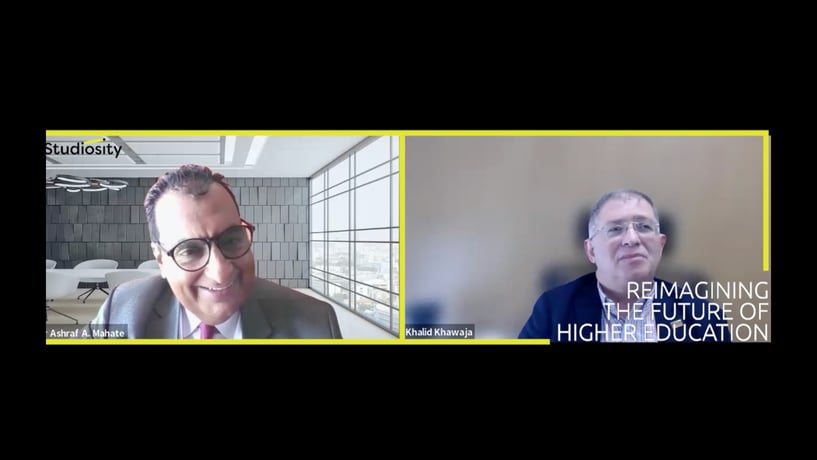
In a recent episode of Studiosity's 'Reimagining Higher Education' podcast, host Dr. Ashraf Mahate sat down with Prof. Khalid Khawaja, Provost and Vice President Academic Affairs of RIT Dubai, to discuss how academic leadership must navigate new technology and greater structural shifts. Drawing from his background in software engineering and higher education executive leadership, Prof. Khawaja outlined how RIT Dubai is preparing students for the future workforce and world.
Applying software agility & "AI value streams" to academia
Throughout the discussion, a central theme emerged around the necessity of institutional agility. Rather than viewing artificial intelligence with alarm or treating it as a silver bullet, Prof. Khawaja shared an approach adapted from software engineering: mapping an "AI Value Stream" across the curriculum.
"You really need to understand your value stream and map your curriculum and your programmes in a way that you understand that and then create an AI value stream so that you are able to deal with the challenges that AI are introducing."
This approach emphasizes intentional, student-centric course design. By identifying where core foundational knowledge must be absorbed independently and where discipline-specific AI tools can naturally enhance the journey, degree programs can ensure students build genuine mastery alongside modern tech literacy.
Solving the experience paradox through scaffolded assessment
The pair also discussed what Prof. Khawaja described as the experience paradox: AI now automates many of the routine, entry-level tasks traditionally used to help junior professionals build expertise. In higher education, this trend reinforces why validating the process of learning, rather than just evaluating a final submission, is more critical than ever.
"So there's so much challenge, I think, for education to deal with, and I think it is not an option to engage in creating a very clear strategy that's very agile, that will allow each and every programme to clearly chart the path for graduating students..."
Prof. Khawaja highlights a scaffolded approach: requiring students to master core concepts hands-on early in a course before evaluating how effectively they can prompt, debug, and accelerate their work using AI in later years or modules.
He stresses that institutions must prioritize supporting the process of learning, rather than focusing solely on the final submission. Institutions are moving toward infrastructure that helps students and educators showcase human capacity for all - what a student knows about their work over time - rather than relying on a single moment of assessment to define valid learning and skills development.
Faculty enablement & defending the degree's ROI
Transforming curriculum requires institutional investment in human capital. Rather than leaving faculty overwhelmed by daily workloads, leadership must prioritize structured enablement. To date, the burden of an AI policy's implementation has been placed on educators and students to work out how these policies translate into reality every day.
institutions must adopt holistic, assessment infrastructure, that ensures integrity and learning validity is based on student agency and educator choice.
Ultimately, Prof Khawaja is deeply optimistic about the enduring value of physical campuses and human mentorship. While technology can deliver information instantly, it cannot replace personalized guidance, peer collaboration, or pastoral support.
"I'm hoping that students will look back and say, you know what, RIT Dubai not only equipped me with the skills required for the time to succeed, and it was just timely, proper, spot on, but they also have taught me how to learn and the value of continuous learning..."
Prof. Khawaja’s reflections highlight a grounded vision for higher education: one where AI is integrated thoughtfully, but the core mission remains supporting student growth, upholding learning, and fostering adaptable, lifelong learners.
🎧 You can listen to or watch the full podcast episode here:
Apple podcasts | Spotify | YouTube | Vimeo