07 Oct 2026 /
Insights
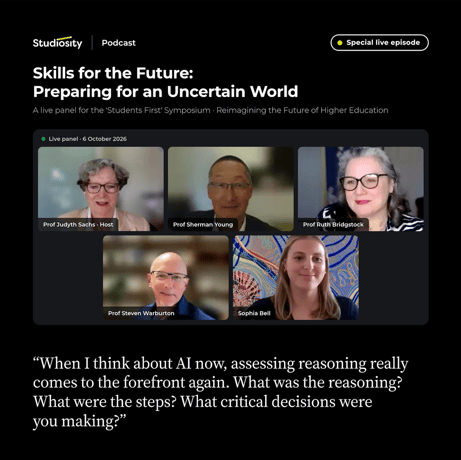
How can universities prepare graduates for workplaces shaped by AI and continual change? Three institutional leaders and a graduating student discussed this in conversation with a live audience.
Earlier this week, Prof Judyth Sachs hosted our live ‘Students First’ Symposium panel with Prof Sherman Young (Deputy Vice-Chancellor Education at RMIT University), Prof Ruth Bridgstock (Professor of Education Transformation - Capabilities at Swinburne University of Technology), Prof Steven Warburton (PVC Education Innovation at the University of Newcastle), and Sophia Bell, a fifth-year Law student at the University of Newcastle.
The rapid escalation of artificial intelligence and shifting workforce expectations have put higher education at a crossroads. Should universities focus on the immediate technical skills that employers require, or build enduring human capabilities that outlast technology cycles? In this panel discussion, academic leaders and a student advocate explored how higher education can successfully navigate the current volatility.
1. Work Integrated Learning (WIL) as an engine for identity
Work Integrated Learning is no longer just an optional internship; it is a fundamental vehicle for students to form their professional identity.
-
Universal WIL at scale: Swinburne University embedded WIL experiences across more than 800 units, in what Prof Bridgstock termed 'WIL everywhere all at once'. As she noted, effective WIL updates itself as work practices change, building essential cultural and social capital.
-
Compulsory work placement: The University of Newcastle has embedded a 140-hour compulsory career-ready placement across all disciplines, using eight distinct delivery scenarios to guarantee equity and access.
-
AAA pedagogy: RMIT University structures learning around Active, Authentic, and Applied (AAA) experiences, ensuring students tackle hands-on challenges regardless of their field.
2. Enduring capabilities vs. transient skills
While AI tools and technical workflows change constantly, foundational human attributes endure. The panel highlighted core capabilities every graduate needs:
-
Agentic Sense-Making - Developing a resilient, adaptive identity and a clear sense of purpose throughout continuous life change.
-
Citizenship - Fostering good human beings who maintain ethical relationships with society and community.
-
Adaptive Expertise - Reflecting on personal knowledge gaps and navigating unfamiliar contexts through structured metacognition.
-
Critical & Ethical Judgment - Evaluating problem framing, reasoning, and ethical consequences in automated environments.

3. Fostering human critical thinking in an AI world
Rather than viewing AI as a separate subject or relying solely on two-lane assessment models, institutions must embed AI as a normal technology within disciplines. Law student Sophia Bell highlighted that while AI can assist in workflows, human critical thinking and verification remain paramount:
"Students need to be able to verify that information is accurate, where that information came from, and if AI actually needs to be used for that particular task."
To lead this transition, universities must empower educators first. As Prof Sherman Young emphasised, lifting staff capability through structured pathways is job one in preparing students for the future.
Ultimately, preparing students for an uncertain, AI-shaped world requires moving beyond reactive, tool-specific skills training and centering higher education on enduring human capabilities. By embedding authentic Work Integrated Learning to foster student identity, prioritising educator readiness, and instilling a culture of critical thinking and good citizenship, universities can ensure graduates do not merely react to technological change.
Instead, they empower students to act as thoughtful, adaptive leaders who maintain their human agency and actively shape the future of work.