26 Aug 2026 /
Insights
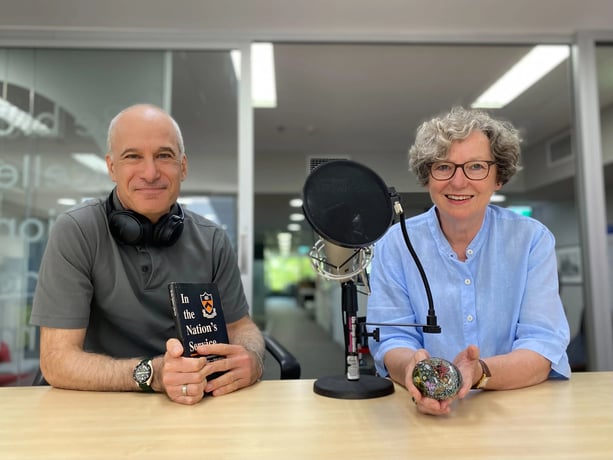
In a recent episode of the 'Reimagining Higher Education' podcast, Studiosity Chief Academic Officer Prof. Judyth Sachs sat down with Studiosity Founder Jack Goodman. Reconvening three and a half years after their last recorded discussion, they explored how generative AI has transformed the sector, shifted student behaviour, and challenged the foundational social contract of higher education. Together, they outlined a vision for an urgent strategic reset centred on trust, foundational literacy, and institutional courage.
Beyond 'police and punish': rebuilding trust in the student-educator relationship
Reflecting on the initial wave of artificial intelligence in higher education, Jack noted that the sector’s immediate reaction was driven by moral panic and short-term tactical responses rather than long-term strategic vision. As foundational LLMs quickly evolved in capability, from being able to ‘pass’ a university course to becoming on par with even a postgrad’s ability, traditional methods of securing assessments have become obsolete.
When unconstrained AI access is ubiquitous, free, and virtually undetectable, the underlying trust between students and educators corrodes. Rather than doubling down on surveillance or punitive measures, Jack advocates for shifting the focus back to student agency and the learning journey itself.

"How do we help put trust back into that teaching and learning relationship? Because without it, there really is a systemic breakdown in this sort of social contract that is the value of a university degree."
— Jack Goodman
By moving away from detection and toward student-led validation, institutions can replace a reactive 'police and punish' model with a culture of continuous learning. Giving students the opportunity to actively demonstrate how their learning journey evolved allows them to provide clear proof of effort, take ownership of their academic progress, and meaningfully rebuild trust in the student-educator relationship.
Overcoming 'cognitive surrender' and 'AI slop'
While the broader conversation in business and government demands that universities produce 'AI-literate' graduates, Jack warned of the hidden dangers facing the first cohort of students completing their degrees alongside unconstrained LLMs. Over-reliance on tools that perform cognitive work leads not just to cognitive offloading, but to cognitive surrender, where individuals lose the habit and capacity to think independently.
As foundation models are trained on internet content saturated with unverified material, they generate highly plausible fictions, aslo known as 'AI slop'. Without strong critical thinking skills, students are unable to separate truth from hallucinated outputs.
"Before you can be AI-literate, you need to be literate. And that's maybe the piece we're forgetting. Let's make sure everyone is literate before they become AI literate. It doesn't work the other way around."
— Jack Goodman
Prof. Judyth Sachs highlighted that true learning inherently involves friction, hesitation, and productive uncertainty. Valuing what AI cannot easily replicate: real-time reasoning, bold questioning, and the messiness of working through problems, is essential to restoring students' intellectual confidence.
A strategic reset: putting teaching and learning at the heart of the mission
Both Judyth and Jack agreed that the rise of generative AI has exposed a long-standing vulnerability in the higher education sector: decades of underinvestment in core teaching and pedagogy, relative to research metrics and global ranking systems. As Prof. Judyth Sachs observed:

"There's been a tactical reactive response rather than a thoughtful strategic response."
— Prof. Judyth Sachs
To navigate the current inflection point, university leadership must resist waiting for government policy or central bureaucracies to dictate the path forward. Instead, institutions must embrace calculated risks, reject one-size-fits-all models, and empower their academic staff to innovate.
The vision ahead: courage in university leadership
Both Jack and Judyth conclude that the future of higher education will not be defined by software or surveillance, but by institutional bravery. Universities that thrive over the next decade will be those that look critically at their existing models, redirect resources toward teaching excellence, and explicitly value human literacy over automated output.
By putting teaching staff and student growth back at the very centre of the university mission, higher education can reclaim its social licence, restore authentic trust, and prepare graduates to lead thoughtfully in an AI-driven world.
🎧 You can listen to the full podcast episode here: