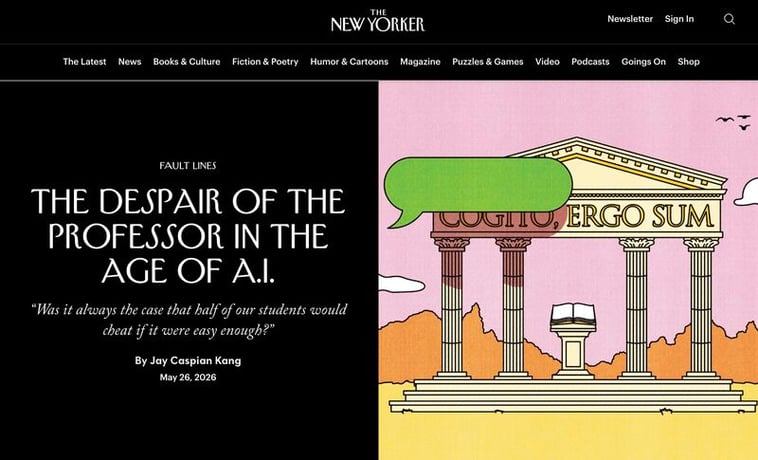
If you’re an educator in higher ed, the New Yorker piece probably feels both familiar and uncomfortable. ("The Despair of the Professor in the Age of A.I.", by Jay Caspian Kang.)
It captures well the exhaustion of teaching a university cohort in 2026.
And notably, the crisis isn't vague or hypothetical or otherwise unknowable; it's now highly specific. It looks like a continually intertwined pattern of:
📍 forced assessment design,
📍 lack of scale,
📍 uncertainty, and
📍 execution of institutional policy.
📈 The scale barrier: "I was able to do a comprehensive oral final... because it was a small seminar with eleven students... scaling this when you have a hundred and fifty-plus students is impossible." - Susanna F. Boxall, Lecturer in philosophy, California State University, Chico.
🧠 Pedagogy at risk: "...what counts as student work, how assessment should change, and how to preserve the kinds of struggle and independent thinking that learning depends on." - Lauren Aulet, Assistant professor, department of psychological and brain sciences, the University of Massachusetts, Amherst.
🦸 Heroic workload: "...students still would use A.I. in a thoughtless way, as a replacement for their thought and judgment. So I made a point to just call them on it, and make them meet with me personally. I saw dozens of students, often for thirty- to forty-five-minute conversations. I wanted to understand where they were coming from." - Daniel Silver, Professor of sociology, University of Toronto, Scarborough.
🚨 Police and punish: "But there is no definitive way to check, and with fifty students I don’t want to spend my time playing “CSI: Who Wrote This Paper?” - Elizabeth Strom, Associate professor, School of Public Affairs, University of South Florida.
Higher education, and educators, need a definitive way forward. And right now.
📍 From July universities will be choosing to Support and Validate instead.
No percentage scores to sift through, and no forensic guesswork.
Your students develop thinking skills, self validate, you keep your usual assessment set up.
We look forward to working with our university partners on this shift from detection back to learning, and invite interested educators and leaders to reach out:
https://www.studiosity.com/validate