29 Jul 2026 /
Insights

At Auckland University of Technology (AUT), academic leaders, teaching and learning specialists, and researchers gathered for Studiosity's annual New Zealand Partner Forum for 2026. This event provides a space to examine how institutions across Aotearoa New Zealand are responding to the rapid integration of generative AI, evolving assessment design, and the ongoing mission to protect student wellbeing and uphold academic integrity.
As Pro-Vice-Chancellor of Learning and Teaching at AUT, Felicity Reid, welcomed attendees by highlighting the value of "collective expertise, curiosity and commitment" in navigating these transformative times.
The Chair for the day's proceedings was Studiosity's Chief Academic Officer, Prof Judyth Sachs, who offered insights from her own perspective still working and consulting in universities in Australia and bringing her anthropological thinking to the discussions via critical inquiry, and insightful facilitation.

1. The shifting AI landscape: exponential uptake vs. the "Trust Gap"
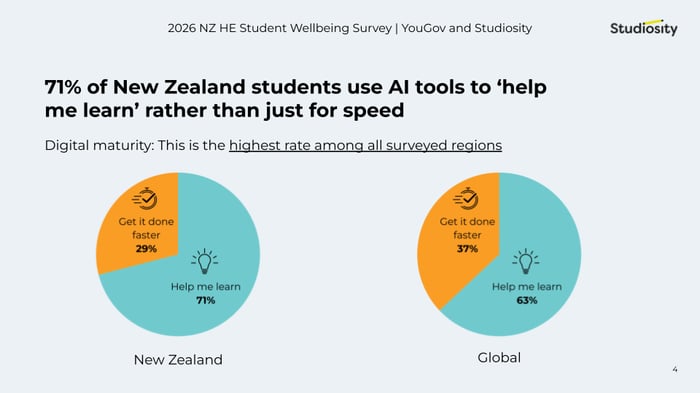
In his presentation on the global YouGov Student Wellbeing survey - which in 2026 included 530 respondents from New Zealand - Studiosity's Partner Manager for NZ, David Farquhar, highlighted that 71% of New Zealand students use AI tools primarily to support their learning rather than just for speed.
However, this adoption is accompanied by rising anxiety, with 52% of NZ students naming the fear of being wrongly accused of AI misconduct as their top AI-related stressor. Additionally, nearly half of the surveyed students expressed concern that AI reliance is eroding their critical thinking and communication skills.
.png?width=700&height=394&name=NZ%20Wellbeing%20report%20deck_%20March%202026%20(1).png)
The data also revealed a drop in peer connection, with 67% of students reporting a lack of access to peer mentors or PASS programmes, impacting their sense of belonging - a challenge particularly pronounced among distance learners and Māori students. Despite these anxieties, student confidence in universities helping them navigate AI has risen from 52% to 62%, showing progress in institutional support.
Learn more and download the full NZ Wellbeing report here.
A primary focus of the forum was Studiosity's transition over the past couple of years from traditional, human-delivered academic feedback to the AI-enabled service Writing Feedback Plus. While the shift has driven unprecedented engagement, it has also revealed complex student attitudes toward automated support.
Jane Henzell, University Academic Support Senior Manager at AUT, shared some interesting data from AUT’s Power BI integration with Studiosity. Since transitioning to AI-generated writing feedback, student usage surged from 95 users in 2021 to over 6,000 individual users in 2025, generating more than 21,700 interactions .

However, despite this rapid adoption, student feedback revealed an unexpected contrast:
"We were initially really surprised at the lack of trust that the students had with AI... While human-led services consistently scored high ratings, the AI counterparts varied. This variation highlights the importance students place on personalised, contextualised support—elements that AI tools sometimes struggle to replicate."
— Jane Henzell, Academic Support Manager, AUT
Henzell noted that while students value immediacy under tight deadlines, their focus remains pragmatic:
"Given the time pressures on students, they want feedback that is absolutely meaningful to them in relation to a grade... The learning aspect is almost secondary and happens in a different place."
— Jane Henzell, AUT

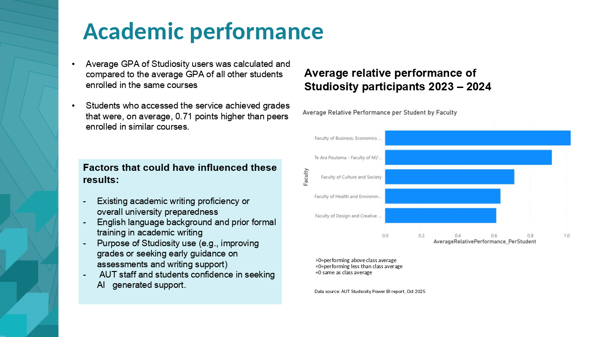
AUT's analysis of relative academic performance revealed that Studiosity users earned grades 0.71 points higher on average than non-users. Jane was quick to note, however, that correlation does not equal causation, and this disparity could be caused by other factors that were not considered in the study.
2. Scaling support and frictionless access
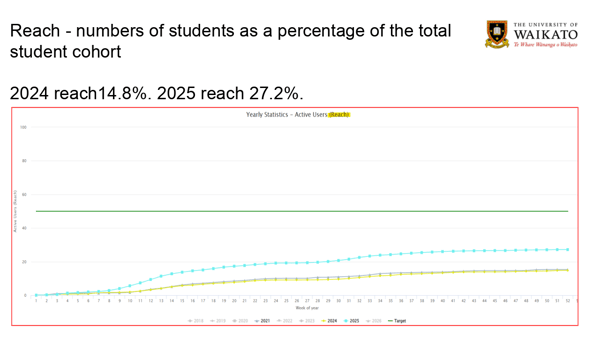
At the University of Waikato, Dr Stephen Powell (Director of Te Puna Ako, the Centre for Tertiary Teaching and Learning) reflected on similar trends. After moving to Plus in 2025 and removing submission limits, Waikato saw weekly interactions leap from a peak of 350 to over 900, with overall student 'reach' jumping from 14.8% to 27.2% of their eligible cohort engaging with feedback.

Dr Powell placed this shift within a broader historical context, viewing generative AI not as an isolated disruption, but as part of a 30-year continuum of educational technology - following microprocessors, the internet, and Wikipedia .
"What it's telling us is that, available kind of on-tap without any kind of friction, students can use support when they need it, whatever that time may be. Sunday is our busiest day, and 61% of usage occurs out of hours."
— Stephen Powell, Director of Te Puna Ako, University of Waikato
Dr Powell posited that the challenge for universities is designing a balanced support ecosystem that makes AI tools available for students directly within the Learning Management System (LMS) while preserving core human connections.
3. Rethinking assessment design: beyond surveillance
As AI tools become ubiquitous, institutions are moving away from reactive "policing" toward authentic assessment frameworks, and focusing on the evidence of learning rather than catching students out.
Felicity Reid outlined AUT’s programmatic "Channel One, Channel Two" assessment model, adapted from the University of Sydney's 'two-lane' approach. Channel One covers invigilated, controlled environments, whereas Channel Two encompasses open assessments where AI is integrated as part of the professional toolkit . Central to Channel Two is the introduction of Points of Observation in Learning (POILs):
"A significant part of this redesign centres on points of observation of learning... where we evidence student learning and development at various stages before the final artefact is submitted. This reduces the emphasis placed solely on the final output and instead takes a process-of-learning approach."
— Felicity Reid, Pro Vice-Chancellor of Learning and Teaching, AUT

4. Integrity as choice architecture and human behaviour
Professor Jason Stephens (University of Auckland) presented findings from the RAINZ Project (Research on Academic Integrity in New Zealand), a national study spanning seven universities and over 4,500 students .
Stephens urged educators to reframe how they view academic misconduct :
"I think I'm getting less concerned with integrity and more concerned with assessment validity... It's not about trying to find students who are cheating; it's about trying to create a situation where they don't cheat in the first instance."
— Prof Jason Stephens, University of Auckland
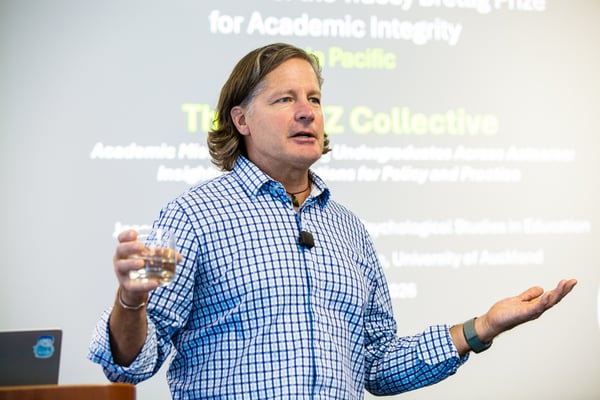
Drawing on evolutionary psychology and behavioural economics, Prof Stephens argued that dishonest behaviour under pressure is a natural human response rather than a moral defect:
"Cheating is natural and normal, but unethical and inevitable... Behaviour is always a function of the person times the environment. As choice architects, us educators are obligated to design environments that mitigate dishonesty."
— Prof Jason Stephens, University of Auckland
5. Validating human effort: moving from policing to process
Matt Henderson, Director of Partnerships at Studiosity, addressed the challenge of degree security by pointing out a fundamental shift required of the HE sector - from surveillance to assessment validity.
Recapping the launch of Studiosity's Validate product following the acquisition of Norvalid in 2025, Matt explained that institutions are moving away from forensic policing and imperfect AI detectors, focusing instead on validating authentic human effort throughout the drafting journey.

By measuring assessment validity across a cumulative "beaker" of evidence, combining human writing indicators, longitudinal voice continuity, and interactive learning evidence questions, the approach turns validation into a restorative teaching conversation rather than a disciplinary hearing, ensuring the degree remains a symbol of genuine human achievement.
Student voices: awareness, flexibility, and real-world impact
A highlight of the forum was hearing directly from students themselves. A 'student voices' panel featuring Joann Masana Dadis (MBA in Operations and Logistics, Auckland Institute of Studies), Rayta Amin (Master of Business in Management - Research, AUT), and Amarjeet Singh (Bachelor of Business graduate, AUT) shared candid insights into how academic support tools fit into their daily lives and study routines.

A recurring theme was the need for institutions to strengthen internal communications around available support services. One student shared that she only discovered Studiosity after a peer showed her how to use it - though once introduced, she became an enthusiastic advocate, discussing how dramatically the feedback improved her confidence and writing accuracy as an ESOL (English for Speakers of Other Languages) student.
The panel also highlighted how support services must adapt to the schedules of modern, working students:
-
24/7 and weekend accessibility: Joann noted that as someone working full-time Monday through Friday, having access to feedback on weekends was a vital lifeline for keeping up with her postgraduate coursework.
-
More iterating, better outcomes: Panelists praised the transition to AI-powered feedback, citing the removal of submission caps as a massive boost compared to classic usage limits; allowing them to submit more drafts more times for feedback.
-
Support regardless of time management: Panelists also mentioned that the speed of the feedback being delivered with seconds rather than hours added additional flexibility, for times when you need a review and some help in a quick turnaround with a looming assignment deadline.
The path forward: human-centred, AI-enhanced
The overarching consensus from the discussions at the forum was clear: while generative AI offers unprecedented scalability and instant formative help, it cannot replace authentic human connection, cultural awareness, or critical thinking.
The road ahead requires a thoughtful, purpose-built model, combining rapid, frictionless AI tools with nuanced, human-led mentoring tailored to the academic conventions of Aotearoa New Zealand.