01 Nov 2026 /
Insights
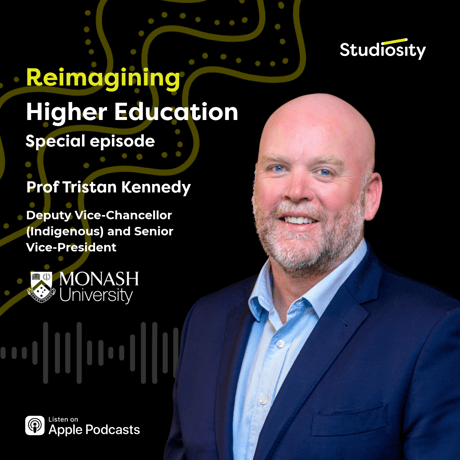
When Professor Tristan Kennedy, a Noongar man and the Deputy Vice-Chancellor (Indigenous) and Senior Vice President at Monash University, looks at the future of higher education, he sees an ecosystem that has moved past the 'checklists' that may still suit other organisations.
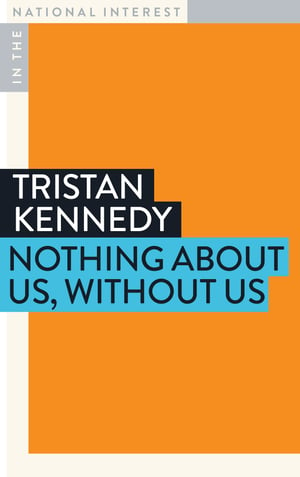
In a recent special episode of the 'Reimagining Higher Education' podcast with Professor Judyth Sachs, Prof Kennedy unpacked the philosophies driving his leadership, and the core themes of his newly published book, 'Nothing About Us Without Us'. The conversation explored how Monash is normalising Indigenous perspectives in academia, and actively challenging the sector’s reliance on standard reconciliation models.
Dropping the RAP for a bespoke Indigenous framework
For many organisations, a Reconciliation Action Plan (RAP) is the gold standard for enhancing outcomes for Indigenous peoples. However, Prof Kennedy made the controversial decision to step away from Monash’s RAP journey when he took up the DVC role. While he acknowledges that RAPs are important for those institutions who are embarking on a 'starting point', he argues that a top 50 global research university such as Monash has the internal capacity to do something far more impactful.
"I made the decision that we wouldn't continue our reconciliation action plan journey as an institution... we can do far greater work that is targeted to Monash, and also to our communities."
Instead, Monash has implemented a custom Aboriginal and Torres Strait Islander framework, heavily relying on the lived experiences of its Indigenous academics and professional staff to dictate its strategic direction.

Understanding "colonial load"
One of the challenges many large organisations face is the reality of "colonial load." While often defined as the extra cultural work Indigenous staff are asked to perform (such as organising the Welcomes to Country), Prof Kennedy argues it is much deeper and more environmental.
By simply walking into historic campus buildings like the Menzies building at Monash, Indigenous peoples are surrounded by artefacts in glass cabinets and archives of information built on Western knowledge systems, that historically justified their dispossession. Prof Kennedy notes that these early colonial frameworks often operated on the deeply offensive assumption that Indigenous peoples were 'lesser' - less civilised or less intelligent. While he opposes censorship of these historic collections, he insists that recognising the impact of this kind of environment is the first step toward institutional truth-telling.
The microscope metaphor: why diverse leadership is non-negotiable
To explain why Indigenous voices must be embedded at the highest levels of governance, Prof Kennedy shared a powerful analogy from his childhood. Growing up, his parents ran a small veterinary clinic, and they had a microscope with four distinct lenses.
"Looking through each lens, you see a totally different picture, yet the sample hasn't changed. If a veterinarian decided to only look through one of those lenses and then make a judgement about what might be needed to treat an animal, they would be doing a major disservice... that would be unethical, right?"
In the same way, designing university policy, research goals, or capital development without an Indigenous lens is an incomplete, flawed process. This philosophy drove the creation of the Monash Indigenous Congress, an advisory body that reports directly to the Vice-Chancellor and the University Council. It also extends globally, with Monash actively consulting the Orang Asli First Nations community in Malaysia, where they have a transnational campus.
A vision for the future of Indigenous leadership
When Prof Sachs asked him what success looks like in five years' time, Prof Kennedy’s vision is clear: the normalisation of Indigenous leadership. Beyond simply having Deputy Vice-Chancellors at the table, he hopes the ongoing process of truth-telling will pave the way for an Indigenous Vice-Chancellor to one day lead an Australian university. Based on the uncompromising, structural work currently underway, that goal feels closer than ever.
🎧 Listen to the full episode:
Apple | Spotify | Vimeo | YouTube
Nothing About Us, Without Us by Tristan Kennedy is published by Monash University Publishing as part of their In the National Interest essay series.