27 Jul 2026 /
Insights
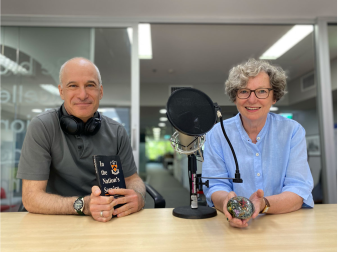
Takeout: When AI can now 'do the work', conversations with 32 higher education leaders point to the standards emerging to assure graduate capability: Zero Cognitive Offload; Evidence before Suspicion; Educator in Command.
DISCUSSION PAPER
When AI can give the answers, this is how leaders are managing graduate capability in an AI era.
Three new standards are emerging; dive into this discussion paper on the conversations happening between university leaders and their peers.
32 leaders | 10 countries & territories
Now in its fifth year, our Reimagining Higher Education podcast series has featured candid, peer-to-peer discussions between university leaders.
These interviews explore leadership journeys, critical institutional challenges, and the evolving and complex landscape of teaching and learning.
In this mid-year synthesis, five themes are clear:
3x diagnoses (The assessment reckoning; From policing to trust; Protect the thinking)
1x mandate (Learning and equity are the point, not technology adoption)
1x view of the stakes (Belonging and public licence.)
From these themes emerged three decision-making principles — where each is an answer to a diagnosis, responds to the mandate, and is in pursuit of the stakes raised by the HE educators and leaders.
Three principles for acting on AI in education.
1. Zero Cognitive Offload
The test: the technology ensures the student, not the machine, does the thinking the credential certifies. Any use of AI that substitutes for, rather than scaffolds, the student's own reasoning fails this standard. For example, a general-purpose LLM is a productivity layer by design and produces no evidence of learning, nor holds an audit trail, nor scaffolds the teacher-learner relationship.
e.g. “…to make sure that students actually can demonstrate what they're learning, even with the use of AI. So that the use of AI doesn't completely replace their thinking.”
Dr Courtney Hills McBeth · Provost & CAO, Western Governors University
2. Evidence of Learning Before Suspicion
The test: the assessment process contains positive, regulator-ready signs of student's own learning, led by both student and educator agency. Owned evidence of learning that can be assured - not simply suspicion of cheating - is the agreement here.
e.g. “…far more authentic assessments that we can assure in a far more rigorous way…”
Prof Clare Pollock · Vice-Chancellor, Edith Cowan University
3. Learning is a T&L partnership
The test: the educator sets the assessment standard, and is enabled to stay in relationship with the learner — as opposed to with the document or constantly with the technology. Check that the technology reduces workload, but is in service to the teaching & learning relationship, not replacing it.
e.g. “AI should free us up to be more human in service to our students.”
Dr Russell Lowery-Hart · Chancellor, Austin Community College District
Breakout: Where do these standards apply?
AI technology is already adopted, that's made clear by leaders around the world in these interviews. But that question, 'should we adopt?' is old. The more relevant question now, that councils, regulators and communities are asking, is 'how do we know the learning is real?'
That's where these standards are applied:
☐ Zero Cognitive Offload
☐ Evidence before Suspicion
☐ Educator in Command
These are both decision-making inputs, as well as ongoing assurances to communities and regulators.
For discussion: The common themes that built the 3 principles.
The assessment reckoning: the artefact on its own no longer proves the learning, and maybe it never did.
The most recurrent theme of the series was a kind of diagnosis, that AI has severed the link between what a student submits and what a student knows. Leaders seem to describe three groups of solutions: structural redesign of curriculum, verification through live or other personal demonstration, and making the learning process itself the evidence.
“A paper, an essay, an exam, even a computer program, often was seen as… representative of student thought and student effort. And that equation has been broken in many instances now by generative AI.”
Vice Provost for Online Education and Digital Innovation at University of Virginia, and Studiosity Academic Advisory Board Member.
“With AI-generated answers now, you can never rely on the classical mode of assessing a student's knowledge.”
President, American University of Ras Al Khaimah
“In the next 20 years, some students will graduate never doing exams in their life.”
Vice President for Academic Affairs, An-Najah National University, Palestine
“If you're afraid your students are going to cheat… why don't you just give them a viva?… then you will know once and for all, if they know their stuff.”
Group CEO, Sunway Education Group, Malaysia
From policing to trust: detection is a dead end
No leader in this series defended surveillance-and-detection as a strategy; several (from four different regions entirely) attacked it directly.
What replaces it - recurring in conversation after conversation - is capability-building, clear guidelines, and assessment that invites students to demonstrate rather than defend themselves.
“They're feeding the work product into another form of AI to tell it whether or not AI was used… then you're making academic dishonesty accusations against students. It just breeds a community of distrust and mistrust.”
President, Complete College America and Studiosity Academic Advisory Board.
“The student feels that they are guilty without evidence… the educator becomes an investigator.”
Studiosity Academic Advisory Board
“Presume good intent by all users… engage with the learner so that they can… utilize it in a way that is more productive and doesn't replace their learning.”
President, Complete College America
Protect the thinking: cognitive offload and the human core.
The first cohort to complete degrees with unconstrained AI access has graduated. What must be protected, leaders argue, is the student's own thinking — and what fills the space that simple "knowledge transmission" once occupied is human: judgement, empathy, curiosity, even the ability to read the room.
“Before you can be AI-literate, you need to be literate… It doesn't work the other way around.”
“Knowledge is not the power anymore… ChatGPT has more knowledge than I and you will ever have if we live 1,000 years.”
Vice President for Academic Affairs, An-Najah National University, Palestine
“We need to be sure that we train our student to not be the bad copy, I would say, of the machine.”
Vice-Chancellor, Sorbonne University Abu Dhabi
“The best thing I think I can do for my students is to help them be still more human.”
President, Singapore Management University
AI adoption is not optional, but the real question is about learning and equity.
No leaders argued for prohibition of AI; many mocked the idea of resistance.
But it was also clear that adoption arrives with standards around cognitive offload, the capability behind degrees, and a warning: the technology will produce winners and losers among institutions and students if: cognitive offload is ignored, if equity isn't considered, and if AI literacy comes before real literacy.
“AI is going to produce winners and it's going to produce losers. And we're going to be surprised who's on each one of those lists.”
Chancellor, Austin Community College District
“If we don't place our oar in the water as it pertains to technology… then someone else will do it for us.”
President, California State University, Fullerton
“You do it, or you will perish.”
Provost & Vice President for Academic Affairs, RIT Dubai
— the same leader adding, in the same conversation, that within every course there is a “certain foundation that you have to make sure that students absorb without AI.” The AI skills of the field come after that foundation, not instead of it.
The licence to operate: value, completion, belonging.
Where AI came up in conversation, there was an often difficult commercial and political discussion: higher education's social licence. Completion, cost, and public confidence were recurring conversations in every region. Leaders described a way forward that looks like: belonging, personal connection, and employability designed into the degree.
“100% of the students who come to our doors come to us because they want a degree. And we disappoint nearly 40% of them.”
President, American Council on Education
“[The] number one thing for a student at Lynchburg is the sense of belonging… we take C students and make them CEOs.”
President, University of Lynchburg
“If it's not about the students, then what's education about anyway?”
Vice-Chancellor, Edith Cowan University
Across all conversations:
Where leadership agrees — and where there is still discussion to be had.
First, consensus:
-
- Detection-and-punishment corrodes trust. There was no defence of the surveillance model in these conversations.
-
- The human capabilities are the graduate attributes that survive. Critical thinking, judgement, empathy, resilience — delivered through relational, belonging-centred scaffolding.
- The human capabilities are the graduate attributes that survive. Critical thinking, judgement, empathy, resilience — delivered through relational, belonging-centred scaffolding.
And the persistent 'fault lines' in conversations:
-
- Disruption versus continuity. This was not whether to adapt but how deep the disruption runs, or: adaptation vs. total upheaval.
- Mode of delivery and community. Differences were seen inside the United States, in particular. However, the disagreement was really about mission and the population served — that is, working adults, dispersed and equity cohorts versus residential school-leavers — rather than about pedagogy itself.
-
- Who drives the change? A regional pattern emerges: "decisive" top-down speed in the GCC and Southeast Asia; "distributed governance" described as the constraint in Australia and North America.
-
- Optimism. While there was pessimism, or caution - there was also confidence that current pressure may force better teaching and learning experiences, grounded in the conviction that “higher education is the future” of societies.
With many thanks again to our recent guests, educators and leaders around the world.
This synthesis covers the most recent 32 episodes of Studiosity's Reimagining Higher Education podcast recorded between July 2025 and July 2026, hosted by anchor Professor Judyth Sachs (Chief Academic Officer, Studiosity), and with hosts Dr Ashraf Mahate, and Professor Noreen Golfman.
Prof Lily Kong
President, Singapore Management University
Prof Adeeba Kamarulzaman
Pro Vice-Chancellor & CEO, Monash University Malaysia
Prof Dato' Elizabeth Lee
Group CEO, Sunway Education Group, Malaysia
Prof Abtar Kaur
Professor of Innovative Digital Technology, Asia Pacific University of Technology & Innovation, Malaysia
Dr Joane Serrano
Chancellor, University of the Philippines Open University
Prof Zlatko Skrbis
Vice-Chancellor & President, Australian Catholic University
Prof Alex Zelinsky
President & Vice-Chancellor, University of Newcastle
Prof Clare Pollock
Vice-Chancellor, Edith Cowan University
Prof Nick Klomp
Vice-Chancellor & President, CQUniversity
Prof Michael Donovan
Pro Vice-Chancellor Indigenous, La Trobe University
Dr Sudhindra Shamanna
Academic President, Manipal Academy of Higher Education, Dubai
Prof Grant Edwards
Vice-Chancellor, Lincoln University, New Zealand
Dr Stacy Young
President, Manchester University, Indiana
Dr Russell Lowery-Hart
Chancellor, Austin Community College District
Dr Courtney Hills McBeth
Provost & Chief Academic Officer, Western Governors University
Dr David Andrews
Chancellor, UMass Global and Studiosity Academic Advisory Board.
Dr Kemi Jona
Vice Provost for Online Education and Digital Innovation, University of Virginia; and Studiosity Academic Advisory Board.
Dr Yolanda Watson Spiva
President, Complete College America, and Studiosity Academic Advisory Board.
Dr Alison Morrison-Shetlar
President, University of Lynchburg
Dr James Beeby
Chancellor, University of Wisconsin–La Crosse
Dr Ronald Rochon
President, California State University, Fullerton
Ted Mitchell
President, American Council on Education
Prof Noreen Golfman
Former Provost & VP Academic, Memorial University of Newfoundland; and Studiosity Academic Advisory Board.
Goldie Blumenstyk
Studiosity Strategic Adviser; 36 years reporting at The Chronicle of Higher Education
Jack Goodman
Founder, Studiosity
Dr Abdulsalam Khayyat
Vice President for Academic Affairs, An-Najah National University, Palestine
Dr Wafa Al Mansoori
Interim President & Provost, American University of Bahrain
Prof Yousef Haik
Vice Chancellor for Academic Affairs, University of Sharjah
Prof Bassam Alameddine
President, American University of Ras Al Khaimah
Prof Imad Hoballah
Senior academic leader, American University of Ras Al Khaimah; former Lebanese minister of industry
Prof Nathalie Martial-Braz
Vice-Chancellor, Sorbonne University Abu Dhabi
Prof Khalid Khawaja
Provost & Vice President for Academic Affairs, RIT Dubai
Citation: Studiosity Academic Advisory Board (2026). Reimagining Higher Education: Leadership Trends, July 2025 – July 2026. Bi-annual synthesis of conversations with university leaders.
Next: