22 Oct 2026 /
Insights
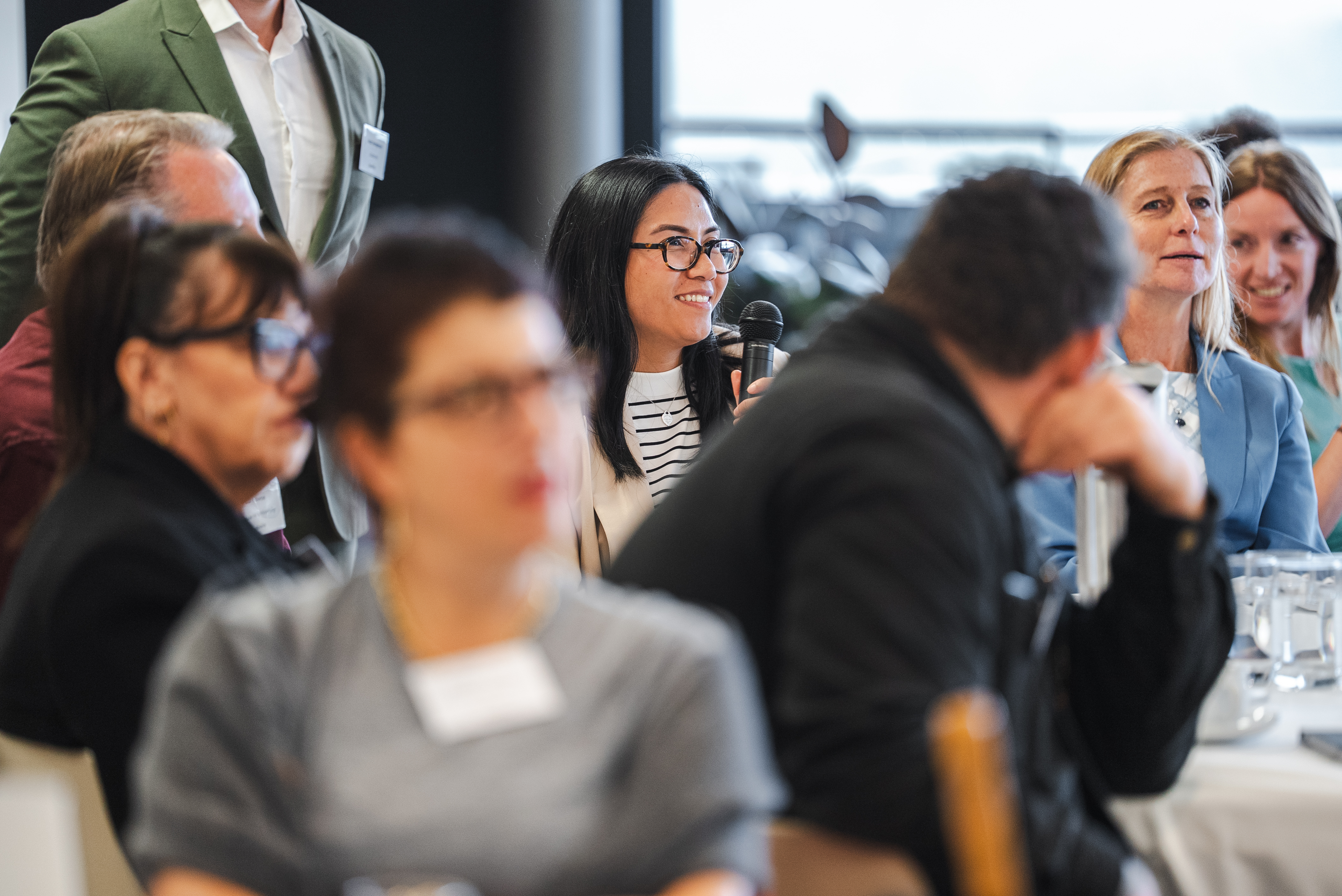
On a rainy Tuesday in Sydney, higher education leaders, academics, and education designers from Studiosity partner universities gathered at the Australian Museum to address the question: 'how do we know the learning is real?'.
Against the backdrop of rapid technological shifts in the education sector, the day was dedicated to exploring this single, vital question.
Jack Goodman, Studiosity's founder, opened the forum by addressing the current situation universities find themselves in, where unconstrained LLM access has upended traditional methods of measuring and assessing student learning. He noted that while humans historically embrace tools that save time and effort, the unconstrained use of chatbots in education has led to alarming trends. Researchers are increasingly documenting effects like “cognitive offloading,” “cognitive atrophy,” and even “cognitive surrender” among students.

However, Goodman reaffirmed Studiosity's foundational mission: to provide tools that enable authentic, equitable student learning. "We believe that writing is thinking", he stated, emphasising that learning requires a culture of trust between students, educators, and institutions, rather than policing and surveillance.
The day's sessions dove deep into how the sector can adapt to this chaotic landscape. Professor Kerri-Lee Krause kicked off the keynote presentations by exploring the current state of higher learning in Australia, venturing that we are experiencing 'ruptured times' (a phrase borrowed from Mark Carney's address in Davos), that require expanded, more inclusive conceptions of learning; more systemic and relational use of data; and more holistic approaches to wellbeing, flourishing and mattering.

Professor Maryanne Wolf, joining virtually from UCLA, expanded on this by diving into the neuroscience of deep reading and cognition. Drawing from the work in her book 'Reader, Come Home', she discussed the reading brain in a digital world. Maryanne highlighted how our increasing dependence on digital technologies threatens our capacity for empathy, reflection, and critical thinking. By outsourcing our reading and writing to machines, we risk losing the deep cognitive connections that define true education.
"The skimmer just looks at the top of the surface of what they're reading and doesn't go below. They are not giving attention, time, or effort... and the best thoughts in that sanctuary are going to be lost."

Following this, Professor Jason Lodge from the University of Queensland asked a provocative question: Can technology make students better at the hard work of learning instead of doing it for them?

Lodge noted that most current AI usage pulls students away from the effortful planning, puzzling, and judgment that learning depends upon. However, by drawing on self-regulated learning research, he proposed that these same AI capabilities can be intentionally designed to scaffold metacognitive processes, ensuring the assurance of learning is maintained.
"Not using AI seems to be an advantage. With one exception: I used it to help me learn."
Studiosity's Chief Product & Technology Officer Greg Hodgson then shared some insights from the recent Validate programs running at several universities, and gave the audience a glimpse of the future of the Validate product. General Manager Chris Fitzpatrick walked through the workflows and showed the room what self-validation really looks like.

The forum also provided practical, on-the-ground perspectives and sharing of best practices from Studiosity's university partners. Sarah Marshall, a unit convener at the University of Canberra , shared her experience teaching in an online Master of Counseling program. Counseling is fundamentally a relational discipline. Practitioners must be attuned to their clients, exercise unconditional positive regard, and remain emotionally regulated—complex human interactions that genAI cannot replicate. With over 3,200 students enrolled in their accelerated program, maintaining authentic connection is incredibly challenging. They use Studiosity to help bridge the gap between the university and the student body, ensuring students are supported 24/7 and with unlimited access to feedback.
The results speak for themselves, with high levels of engagement and higher average GPAs for Studiosity users, as well as lower rates of dropout.
Perhaps the most illuminating insights came directly from the students themselves. A panel featuring students from Macquarie University, UNSW, and the University of Notre Dame shared exactly how they navigate the modern university experience.
Marina, a mature-age law student, explained that while AI has been helpful for understanding the archaic English used in old legal judgments, she still heavily relies on the interactive discussions in her tutorials to build critical thinking skills. Aanchal, an international student studying Primary Education, shared that she uses AI strategically to deconstruct complex assignment rubrics and prompts into clear, actionable checklists so she avoids misinterpreting task requirements - but doesn't let it do her work for her.

Luna, who balances her Master of Public Health with a demanding nursing schedule, discussed how essential on-demand feedback is for keeping her learning on track when balancing work and study. Finally, Aastha, an international Bachelor of Psychology student, voiced a shared concern among the group: while AI offers undeniable benefits for planning and organising tasks, students must consciously resist the urge to over-rely on it, as doing so risks eroding their own critical thinking skills. Collectively, the panel underscored a central theme: meaningful learning is an active, effortful process, and these students are determined to stay in the driver's seat of their own education.
Ultimately, the 2026 Partner Forum made it clear that while the tools of education are changing, the fundamental goal remains the same. We must see through the “illusion of competence” that genAI so easily creates. By empowering educators to integrate AI in ways that are structured and institutionally-approved, and supporting students to demonstrate their genuine capability, we can retain the degree as reliable proof of human effort and learning. Whether augmented by AI or not, the learning must be intrinsic to the student. Together, we can ensure we keep the learning real.
