13 Apr 2026 /
Insights

At ACEx2026, hosted by ACE in Washington, DC, USA, Dr. Tim Renick and Dr. Kathryn Crowther recount Georgia State University's history and the changes in their student body over time, leading to the university's need for scalable solutions to meet students needs, and the success they've seen through GSU- and NISS-led initiatives.
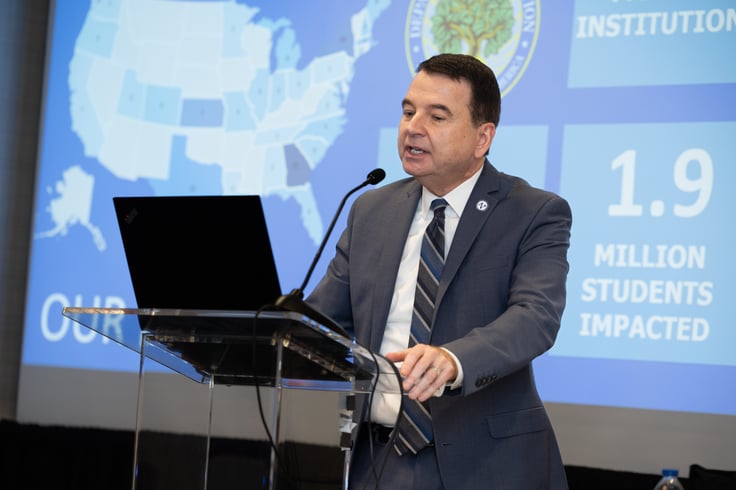 Watch the full video here >> [59:11]
Overview of Georgia State University
"I'm gonna start this morning by setting the stage, by pointing out that this kind of work has developed over the course of really a decade of trying to see ways to be more equitable in our delivery of student supports to students at institutions that may not be particularly well-resourced. And that's a good description of Georgia State University. We're one of the largest minority-serving institutions in the country, 53,000 students across six campuses. Our main campus you're looking at in this picture, it's downtown Atlanta. Our claim to fame nationally is not being particularly strong in any reputational area."
A history of segregation
"Historically, what we've best been noted for, maybe the most distinctive trait, is our geography, right? Our campus is bisected by a National Park Service Historic District. The Martin Luther King District slices our campus in half. My office every morning is a building on Auburn Avenue, a few blocks away from the brick building at the bottom of the screen. That's Ebeneezer Baptist Church, where the Reverend Martin Luther King was head pastor. His grave site, his childhood home, all located right in the midst of Georgia State University. But the sad reality is that for much of our history, we didn't live up to that legacy. I pulled these photos from the Georgia State photo archive. That's what Georgia State looked like when the Reverend King was doing his Nobel Peace Prize winning civil rights work.
And we were whites only, a segregated campus into the 1960s. So sad irony of that, this great world leader in civil rights is preaching a couple blocks away from a campus that is the embodiment of what he's fighting against. But even much more recently than the 1960s, Georgia State was still grossly underperforming, especially for our students of color.
So these were our Bachelor's graduation rates as of about 20 years ago. They hovered around 30%. They were even lower for students from underserved backgrounds, Black, Hispanic, low-income students. And it was so predictable that we weren't surprised year after year when we would see this pattern repeated. And what made Georgia State's story both interesting, I hope, for your purposes, but also a good testing ground for some of the approaches that we're gonna be discussing this morning is that while Georgia State was starting at this low baseline, 30% graduation rates, we didn't have a lot of things working in our favor."
.png?width=1280&height=720&name=ACE%20Renick%20Crowther%2002%2028%2026.pptx%20(1).png)
A shift in demographics
"In the 20 years since then, we've gone through very dramatic demographic changes that usually don't correlate to greatly improved graduation rates. So a student body that when I arrived as a junior faculty member out of my PhD program was 75% white, now 80% of the undergraduates self-identify as non-white. There's no majority population at Georgia State. The largest single demographic group are black students now, about 40 percent of the student body. Obviously that typically does not correlate to greatly improved graduation rates, nor does this second detail on the right of the screen there. We've gone through another transition over the same period where our students have gotten a lot less well-resourced financially. Before the last recession, under a third of our students were Pell eligible. That number now is around 60 percent. This spring term at Georgia State we're currently enrolling 29,000 Pell students, so 29,000 low-income students at one campus."
Finding scalable solutions
"I am saying when you enroll 29,000 low-income students, you don't create a program for them, right? You need to come up with strategies that scale across the whole student body. So what we did at Georgia State now, starting really about 15 years ago, was take a different approach. We began to put the focus on our own processes and systems, not because they're the only reason students were dropping out of Georgia State.
Yes, some students were dropping out because they were academically underprepared. Some students were dropping out because they financially strapped and couldn't afford to stay enrolled. But we focused on the issues that were under our control because these were areas that we could potentially correct and improve student outcomes. So, we got better with the data. We use the data to analyze our own systems, and when we found a system or a support that was failing our students, what we did is we piloted alternatives and then scaled them up across the student body.."
The impact of change
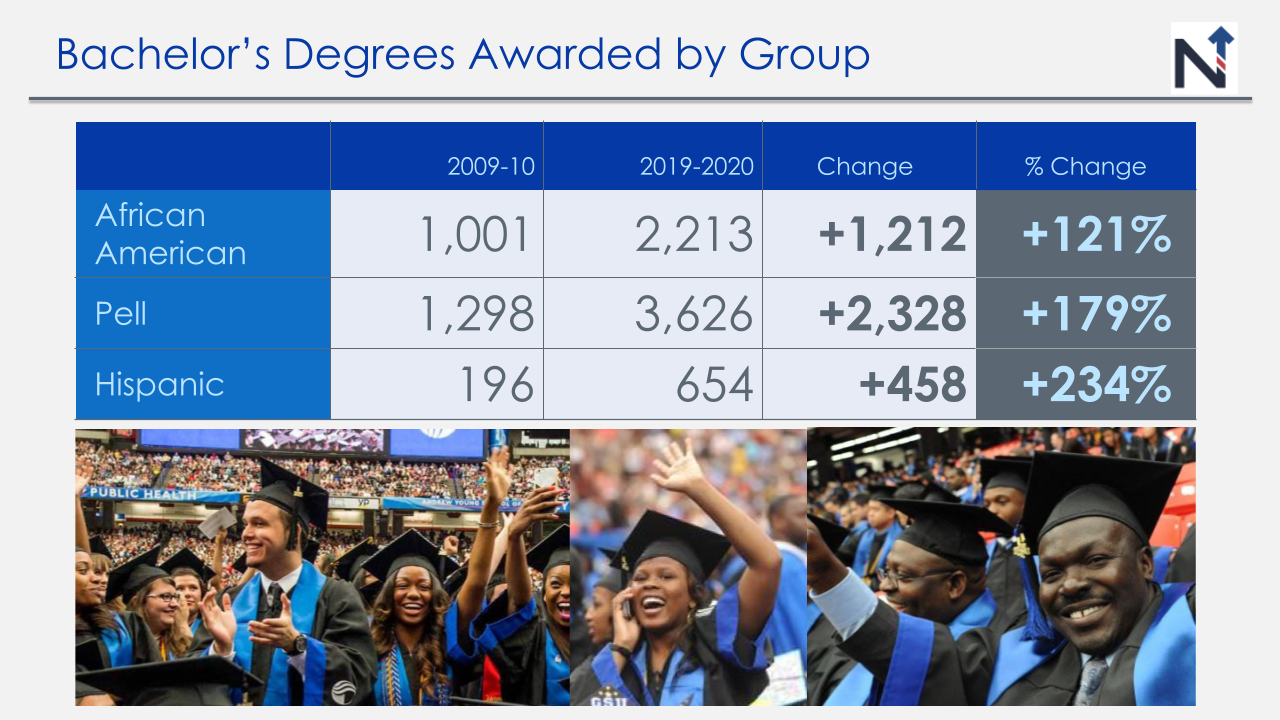
"So these have been part of the strategy to deal with a student body that is facing risk factors across the board. Have they been impactful? Well, over the last decade, despite those demographic shifts you saw a moment ago, Georgia State is graduating 3,500 more students every year, an 84% improvement overall. But the biggest gains in degrees awarded have been for the students who are struggling the most before we did these scaled, systematic, and proactive supports. So we're up 84% overall. You can see from this screen much greater increases for our Black, our Pell, and our Hispanic students. Because those gains have been not only strong, but disproportionately powerful for students from underserved backgrounds, it's had a profound impact on our graduation rates [...] For some demographic groups, they've more than doubled. They've come close to tripling.
And we've had seven years in a row now where our Black, Hispanic, and low-income students are graduating at or above the rate of the student body overall. So no equity gaps, at least based on race, ethnicity, and income when it comes to graduation rates. And this institution in the shadow of the Martin Luther King District that was segregated into the 1960s and still grossly underperforming for our students of color a decade or so ago, now, and it's been for seven years in a row as well, confers more Bachelor degrees to African American students than any other college or university in the U.S.."
Equitable access
Because we're enrolling more and more low-income students, many of them have jobs, we know at Georgia State 80% of our undergraduates have jobs, but we still set up these structures like they're going to be free at 3 in the afternoon or 9 in the morning to get these issues settled and I talked to the people who run these offices, they're frustrated. Yeah, we sent an email and said they should come, you know, to this session at 10 a.m. On a Tuesday and they didn't show up. No kidding, they have these complicated lives, they have jobs and families and so forth.
The chatbot was able to answer their questions even off-hours. So did this make a difference? It made a huge difference. We've lowered the summer melt rate at Georgia State from 19% to basically 9%. Students haven't gotten any more savvy about navigating verification requests from the federal government, we got a little better at supporting them.
Watch the full video here >> [59:11]
Interested in learning more? Review results for GSU and NISS's Studiosity pilot here, or read through the full transcript here.