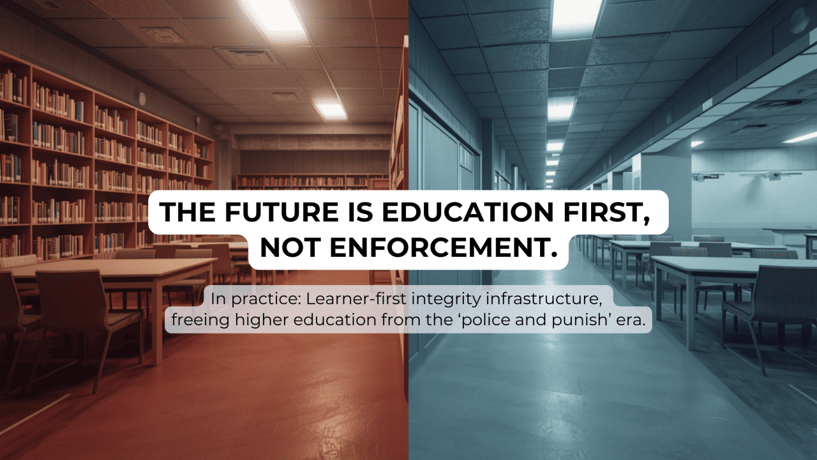
The 'promise' behind a degree to students and industry has always been that a graduate can think.
Today, that promise is under pressure from:
- Technology that was not designed for education, but is widely adopted and also provided to students by their institution,
- Institutional enforcement that seeks to police that same access provided to students,
- Pressure on educators to be in the role of enforcer, to deploy new institutional AI policy frameworks.
It’s time for a new path.
We believe learning is a human act of thinking, the process of skills development, of "working out" an answer. Learner first, not artefact first. But right now, students themselves are increasingly frustrated by the "Learning Confidence Gap" and want more agency over that struggle and authorship journey. It's clear that establishing author continuity and multi-layered, robust validity for the skills behind the artefact must now be the baseline for all students. And this shift is vital whether the goal is joy of learning, degree reputation, or career-readiness.
The urgency behind an obsolete and damaging status quo
Tech 'solutions looking for problems' were not designed for this moment in 2026, nor were detection and surveillance-first systems. Over time, these original slices of overall educational integrity dwarfed learning outcomes as a priority.
And now the urgency is even greater. More than just being obsolete at this point in time, 'Police and Punish'-first systems impose a growing 'surveillance tax' on institutions, as time, pressure on educators, as well as legal and financial repercussions. Worst of all, it has led to the normalisation of an unsafe - us vs them - teaching and learning environment for educators and students.
Integrity infrastructure that supports the learning journey
In collaboration with our global university partners - leadership, educators, staff, students - and referring to best practice from the sector as well as acquiring a specialist platform, we designed Studiosity's 'Support and Validate' assessment integrity infrastructure.
Studiosity develops human skills, and empowers students and educators to validate that effort and thinking.
It gives students the agency to:
- Create, think, and learn for each assessment, and to know that any effort here contributes to a review of their overall assessment.
- Engage in pedagogy-first, formative feedback and critical thinking development prior to final submission, or revisit if they need to exit final submission;
- Understand institutional AI policy while feeling safe and confident - not 'watched'.
It enables choice for educators, to:
- Teach, not police.
- Set the level of AI use that is pedagogically fit for students or the task.
- Validate student effort through a multi-layered journey of formative feedback and authorship continuity - not with an integrity score on the artefact or task itself.
It offers institutions the scale and confidence to:
- End the unwinnable arms race, by choosing learning first over policing.
- Enable educator or faculty choice around assessment,
- Justify and apply AI policies or frameworks (e.g, multi-lane, AI for Assessment Scale, both, or other layers),
- Restore trust in the teaching and learning environment - and the learning behind degrees to the public and regulators.
Because learning is the point
Trusted university degrees in the next decade will be from institutions that put a guarantee of real learning development behind every graduate.