06 Jul 2026 /
Insights
The 2026 Singapore Student Wellbeing Report, with research undertaken by YouGov and reported by Studiosity, says that 93% of Singaporean university students are using AI, yet:
-
-
almost half fear it is eroding the very critical thinking skills they need for the future
-
three-quarters experience some level of stress while using AI tools for study
-
over eight in ten (85%) are worried about being "wrongly flagged by AI detection tools" when they submit assignments
-
nearly half of students who felt AI-stress (46%) ranked ownership of their work among their top three stressors
-
Stress around critical thinking reduction
While a majority of Singapore's university students maintain a level of confidence in their learning, the fact that 45% fear it is eroding their critical thinking suggests an emerging dependency concern. These students are voicing a complex anxiety that by outsourcing the "heavy lifting" of deliberation to AI, they are actually weakening the muscles of creativity and problem-solving that a university degree is meant to build.

Desmond Lee, Singapore's Minister for Education, said recently that AI use in education should "avoid what we call cognitive offloading. That means they let AI do the thinking for them, and while they get the product, they don't actually learn.”
The awareness among students of this offloading reveals a cohort that is far from naive; they recognise that while AI can simulate the outputs required for learning, it is no substitute for the struggle and disorder required of human thought - and they are increasingly worried that, in the race to get things done faster, the process is being lost entirely.
“It takes away the part where I have to deliberate on a certain question or topic.”
– 3rd year Business student, West Region
The 'detection first' burden on students' wellbeing
Recent articles in The Straits Times reveal a number of publicly-reported cases of AI-driven cheating in Singaporean universities. The data from the 2026 Singapore Student Wellbeing Report highlights the problems with the "police and punish" model of academic integrity. When 85% of students are stressed about being falsely accused of cheating, the primary driver of anxiety shifts from the workload itself, to a fear of the systems meant to monitor them.
Overall study-related stress has jumped from 59% to 68% of students feeling stressed 'weekly or more', in just one year, with this fear of false accusation one of the driving stressors. Singapore's students also experience some of the highest levels of stress when using AI, compared to other surveyed regions.
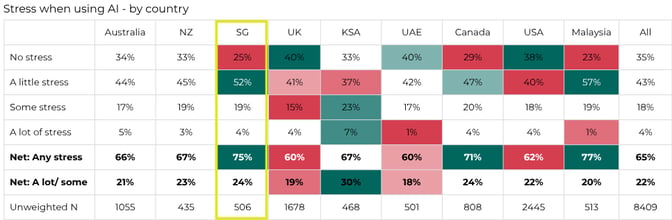
Even where ethical guidelines are provided by the university, nearly a quarter of students (24%) who have access to them still rank "uncertainty about AI rules" as a top stressor, suggesting that 'police and punish' policies are creating a climate of fear rather than clarity.
How can Singapore's institutions better support students' wellbeing with these factors causing so much additional stress? Institution leaders must move from AI policing to learning validation. The value of human-centric and pedagogy-first frameworks has never been higher.
"Universities have focused so much on cognitive thinking that we sometimes forget the holistic individual... The best thing I can do for my students is to help them be still more human - to understand history, human frailties, and how to read the room in ways AI cannot."
- Prof Lily Kong, President of SMU, speaking on Studiosity's 'Reimagining Higher Education podcast
-low.gif?width=640&height=360&name=Prof%20Lily%20Kong%2c%20President%2c%20Singapore%20Management%20University%20(SMU)-low.gif)
A more human, learner-centric path forward
Universities are moving away from the punitive, detection-first approach to policing AI use, and providing a more robust, pedagogy-first framework for students and educators to work within. Because learning is the whole point of a degree, graduating thinkers rather than AI-prompters is the mission of the higher education sector.
The data is clear: Singaporean students aren’t looking for a shortcut; they are looking for a safety net.
By shifting the focus from detection to validation, and from suspicion to support, we can put learning first and prioritise human-to-human connection in higher education.
In this way, universities can begin to ease the shadow of AI stress that currently darkens the student experience in Singapore.
Download the full 2026 Singapore and Malaysia Student Wellbeing Report here.