28 May 2026 /
Insights
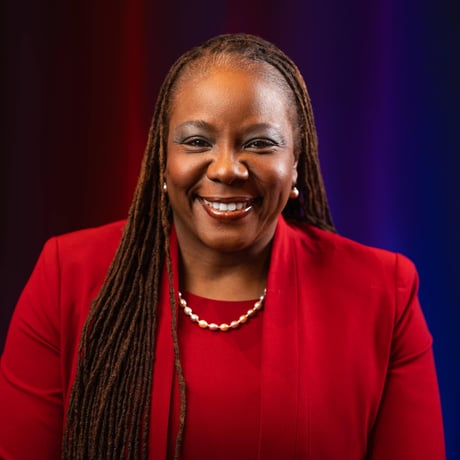
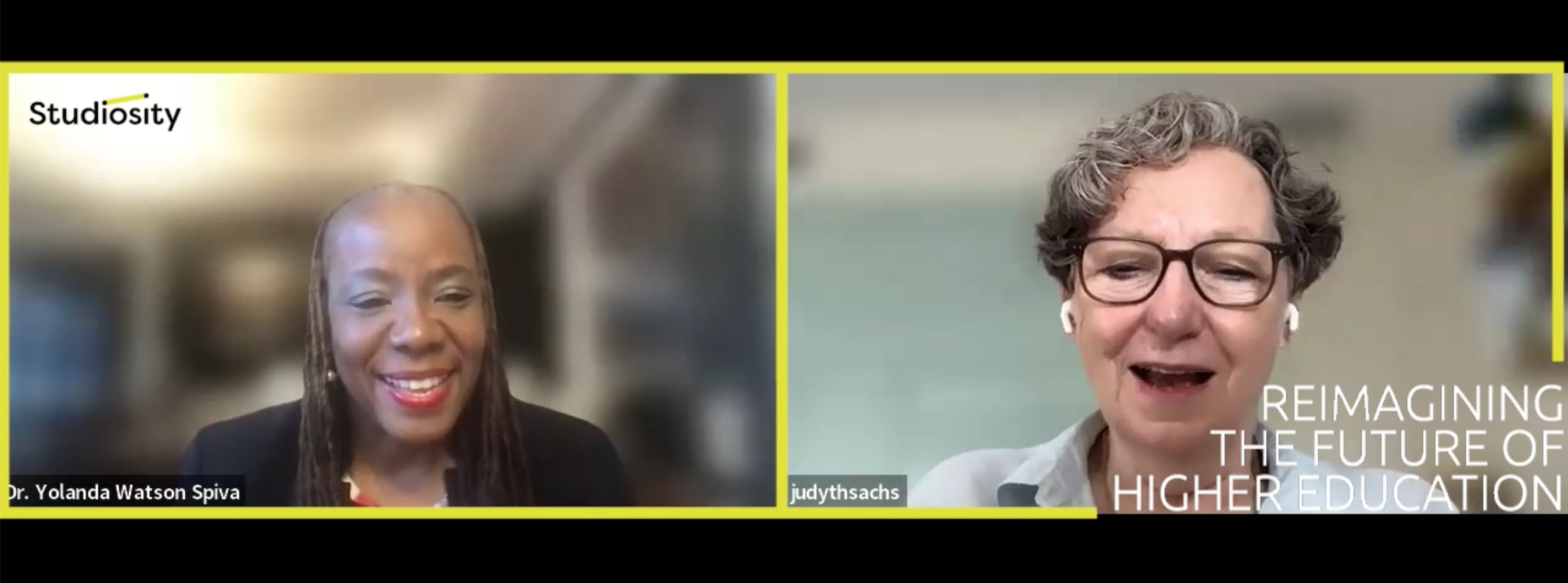
 In this episode of the Reimagining Higher Education podcast, Professor Judyth Sachs sits down with Dr. Yolanda Watson Spiva, the President of Complete College America (CCA) and Studiosity Academic Advisory Board member. With a career that spans the U.S. Department of Education, faculty roles, and nonprofit organizations, Dr. Watson Spiva has developed a rare "bird’s eye view" of how policy is formed, delivered, and practiced. Her mission is clear: ensuring that every student, regardless of their zip code, has the opportunity to not only enter higher education but to persist until completion.
From Economics to Equity: An Origin Story
Dr. Watson Spiva’s journey into leadership began as the eldest child in a family of educators, where the question was never if she would attend college, but where. While she initially majored in economics and finance with an eye toward accounting, and did a master's in public policy at the graduate school of the University of Chicago, an internship with the organization Leadership for Quality Education got her interested and curious in education.
Her "aha moment" regarding equity occurred while working as an academic administrator. She witnessed valedictorians and salutatorians from certain high schools being placed in remedial math and reading courses upon entering university.
"I was confused about how that could be... then you start to delve into the inequities of education and how being the top of your class in one zip code could mean something totally different than another zip code."
This realization fueled her quest to level the playing field, a journey that led her through various federal departments - from financial aid audits to the Office of the Secretary - before taking the helm at Complete College America.
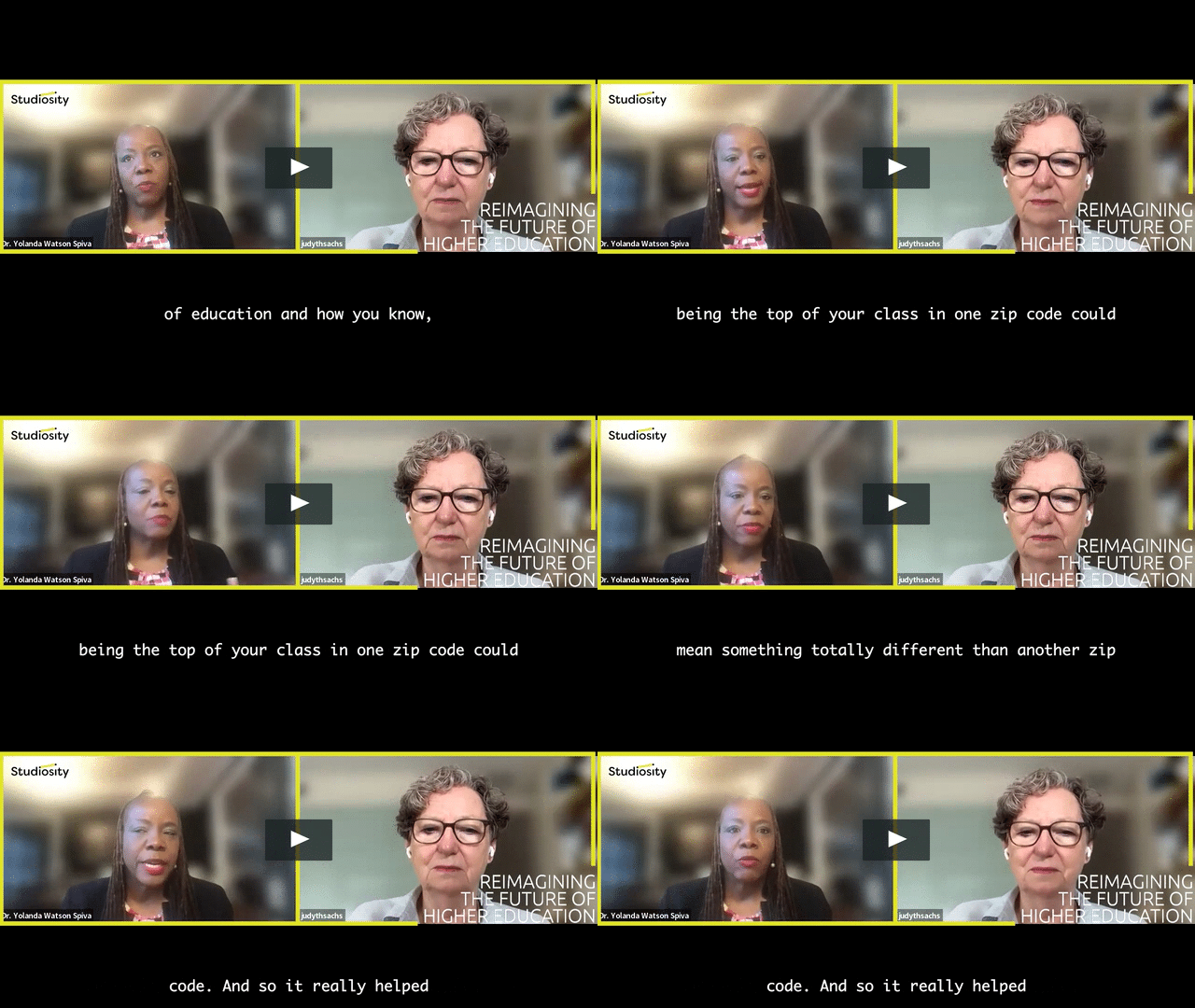
Watch the full interview on Vimeo here
AI and the "Brass Tacks" of Inequity
Before leading massive institutional changes, Dr. Watson Spiva remains curious about how AI can increase capacity - but only if it is handled with care. She warns that if we do not have an equitable distribution of who is informing or "feeding" information to AI, we risk creating an automated system that simply perpetuates existing inequities. Beyond the software itself, she points to "brass tacks" inequities such as basic access to computers and Wi-Fi, but also understanding how to utilize the tool. In her view, the future of work will belong to those who have the requisite knowledge to be "drivers" of AI. However, students in under-resourced zip codes often lack the exposure to these use cases, creating a new divide between those who interface with technology and those who are displaced by it.
"I think many of the jobs going forward are going to be about who has the experience and the requisite knowledge about AI in order to be a driver of it."
Moving from Policing to Learning
When ChatGPT first launched over three years ago, a lot of the initial responses were around policing and punishment. Dr. Watson Spiva argues that if we spend all our time on enforcement and surveillance, we miss the profound opportunities AI affords for capacity building and efficiency.
She advocates for a "learning and leading" approach where faculty and students provide the professional development necessary to help both teachers and learners understand digital literacy in an AI-enabled space. Rather than presuming everybody is starting at the same level of awareness and knowledge, we need to try level the playing field.
What is Complete College America?
CCA is not a traditional college, it is a massive alliance impacting approximately 10 million students across 53 states, systems, and consortia. Dr. Watson Spiva describes the organization as an "army" focused on winning the war against students "stopping out".
"Our work is really around scaling best practices across institutions, we believe in taking the best of what is happening at various institutions and trying to extrapolate it across the United States."
The organization functions through a decentralized alliance, where governance remains at the state level but is supported by a central backbone. This structure utilizes state-based leads in policy, data, and student success as "tentacles" across the country to drive local change. By pairing content experts with institutions, CCA aims to scale promising practices immediately. The goal is to ensure that a student's desire to learn is met with a system that provides ladders to success rather than institutional barriers.
Universal Design: Normalizing the Human Experience
Looking toward the future, Dr. Watson Spiva believes the sector must embrace universal design to address the mental health and neurodivergent needs of the modern student. Rather than treating mental health support as an "add-on" for students on the fringes, she argues that institutions should bake these supports into their core infrastructure.
"We presume they're going to probably have some sort of mental health challenge. We presume that they may be neurodivergent, and so we build that into the infrastructure and the ways that we behave as institutions and interface with students and provide supports for them."
This proactive approach recognizes that the "typical" student is a diverse mosaic - adult learners, parents attending classes with their children, and students struggling with food or housing insecurity. By designing for the most vulnerable, institutions create a more robust environment for everyone.
Personal Insights
-
The Quaker Way: Dr. Watson Spiva lives by the saying, "Be open to the way and the way will open." She encourages students to avoid the trap of a "unilateral prescriptive" life plan and instead remain open to a journey that will likely include fits, starts, and careers that don't yet exist.
-
The "Yes" Philosophy: She advocates for saying "yes" more than "no". In her view, foreclosure of options often stems from saying "no" too early in the curiosity phase.
-
Current curiosity: She is currently reading the Gates Foundation’s Annual Letter regarding the road to 2045 and the Lumina Foundation’s 2040 goals. Both center on the long-term future of completion and what the next two decades portend for learners.
Listen to Dr. Watson Spiva's full episode here: Apple podcasts | Spotify | Vimeo | YouTube