28 Dec 2025 /
Insights

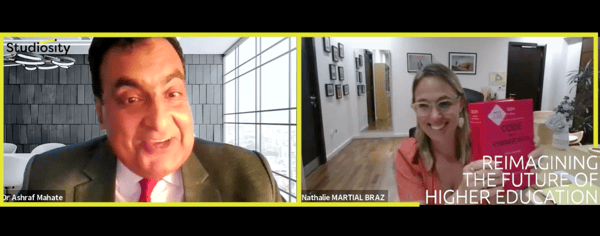
 On the 'Reimagining Higher Education' podcast, Dr Ashraf Mahate recently interviewed the Chancellor of Sorbonne University Abu Dhabi, Professor Nathalie Martial-Braz, on the evolving landscape of academia. She shared a vision for higher education that bridges centuries-old traditions with the rapid-fire disruption of the digital age. Drawing from her background in private law and her journey from Bordeaux to the UAE, Prof Martial-Braz offers a blueprint for institutional leadership that prioritises agility, humanity, and a commitment to "never stop being a student."
The 'Student-First' Philosophy of Leadership
Prof Martial-Braz’s approach to leading a prestigious university is rooted in her own experience as a curious, dedicated student. She believes that effective leadership in higher education requires maintaining the perspective of those sitting in the lecture halls.
"I am first a student, secondly a teacher, and now I’m a leader... I think you cannot be a leader of this sort of institution if you were not by the past a professor and a former student of the university."
This mindset drives her to constantly self-assess her teaching and leadership, asking whether the current academic offering would have satisfied her own curiosity as a student.
We ask every guest on the podcast to bring an item that represents them as an educator and a leader. To symbolise her journey, Prof Martial-Braz referred to a thick Cybersecurity Code book. It looks like the classic Civil Law codes she used as a student in the 1990s, but the content is entirely new. This serves as a metaphor for her entire philosophy: the framework and values of the university remain, but the "code" must be rewritten for every new challenge the world presents.
Balancing the 'Market' with the DNA of the University
Modern universities face a difficult paradox: they must operate within a competitive market with KPIs and metrics, yet they must preserve their core identity as centres for free thought. Prof Martial-Braz acknowledges that while quantity and financial sustainability are realities, they must not come at the cost of "originality" and "imaginative" thinking.
To meet these market needs without losing the 'DNA' of the university, Sorbonne Abu Dhabi focuses on high-impact agility:
- Targeted Programs: Onboarding only those programs that fit the UAE’s national strategy, such as AI-focused mathematics and quantum physics.
- Industry Advisory Boards: Using filters from the public and private sectors to ensure students are marketable from day one.
- Microcredentials: Launching flexible learning paths, like marine sciences within geography degrees, to address immediate regional challenges like rising sea levels.
Embracing the AI Revolution as a Tool for Thinking
While many academics fear being replaced by Artificial Intelligence, Prof Martial-Braz takes a singular, proactive stance: AI must be embedded into the curriculum. She argues that since the revolution is already here, the goal is not to compete with the machine on information retrieval, but to surpass it through critical reasoning.
"Our function is not to transfer information, our function is to transfer the thinking, the reasoning process. And if we see us as is, we won't be replaced by the machine."
She illustrates this with a personal anecdote about her daughter, who received a zero for a ChatGPT-generated dissertation that was full of "wrong stories" and "false references." This failure taught her daughter to use AI as a "sparring partner"—a tool for testing ideas and correcting exercises rather than a source of truth.
The University as a Modern Agora and "Sandbox"
For Prof Martial-Braz, the university is more than an educational body; it is the "epicentre" or "agora" of society. This means the institution must be a space where life changes and different worlds link together.
One way Sorbonne Abu Dhabi is pursuing this is through its upcoming incubator, designed as a "sandbox" for student entrepreneurs.
"We want to be this place where you try and you can fail. That’s also important."
Beyond startups, the social impact extends to the community through things like inclusive sports centres for disabled people and public health awareness campaigns, making the university meaningful and impactful beyond just its enrolled students.

Img source: sorbonne-universite.fr
Addressing the Mental Health Challenge of Gen Z
Perhaps the most significant challenge Prof Martial-Braz identifies, is the mental health of the "COVID generation." She describes a student body that is highly anxious, influenced by social media and global geopolitical instability.
Educators, she argues, must do more than teach; they must help this generation find the methods to face a world that feels increasingly fragile.
Ultimately, Professor Nathalie Martial-Braz envisions a future where higher education serves as a dynamic, central hub where the tradition of academic excellence meets the agility of the modern market. By positioning herself as a student first, she advocates for a leadership style that prioritises critical thinking and human reasoning over the mere transfer of information, ensuring that we're not setting our students up to be replaced by AI but are empowering them to use it as a sophisticated tool to augment learning.
Through this balance of tradition and innovation, she aims to provide a "safe sandbox" where the next generation can fail, learn, and eventually lead in an increasingly complex world.
🎧 Listen to Prof Martial-Braz's full episode here: Apple | Spotify | Vimeo | YouTube