16 Feb 2026 /
Guest writer - Dr Zheng Ma

 This guest blog, written by Dr Zheng Feei Ma, Senior Lecturer in Public Health, SSHSW, College of Health, Science and Society, University of the West of England, Bristol, was originally published here, 15 Dec-25. Dr Ma specialises in advancing learning and teaching by applying evidence-based approaches to curriculum design, assessment, and student support.
UWE Bristol has partnered with Studiosity since 2022, providing 'pedagogy-first AI' study support and peer-to-peer connection to all 32,000 students. With 96% student satisfaction and self-reported improved confidence ratings (UWE Bristol Case Study), Dr Ma wanted to dive a little deeper to understand how Studiosity is developing student's critical thinking and writing skills.
Introduction
Critical thinking is widely recognised as a core attribute of graduate in higher education. However, for many students, particularly international students for whom English is their second language, developing this skill can be challenging. I often meet students who express uncertainty about what critical thinking looks like in practice, how to apply it in their assignments, and how to move beyond descriptive writing to critical analysis, evaluation and synthesis. Therefore, as educators, we have a responsibility to demystify the process by creating a structured, supportive learning environment, which helps students strengthen their critical thinking skills.
One increasingly valuable study support service tool for developing students’ critical thinking and writing skills is Studiosity. It is an AI-driven personalised learning support platform used across many UK universities. Since Studiosity is available 24 hours a day and 7 days a week, students can upload their assignment drafts anytime to their online interface for feedback, which allows them to improve their assignment drafts. The Studiosity platform reviews their work and provides guidance on grammar, spelling, academic language, structure and referencing.
"I appreciated the feedback. It helped me more confident in submitting my work. Thank you". - Postgraduate research student.
When embedded thoughtfully within the learning and teaching practice, Studiosity provides the developmental and formative feedback that supports students, ultimately strengthening their critical thinking skills.
Therefore, in this article, I will offer three steps for integrating Studiosity into the development of critical thinking and writing skills in students. In addition, I will share my reflections, along with feedback from students on how educators can use Studiosity effectively to help students build their confidence and achieve academic success.
See Studiosity for yourself with this interactive walkthrough:
Step 1: Developing questioning and inquiry skills
Studiosity has two core services, which are: Connect Live and Writing Feedback. Students can use the Connect Live function to interact with (human) online specialists who prompt the students to articulate their reasoning and identify gaps in their arguments. During these sessions, students can pick a subject in the live chat, including “English skills and concepts”, “Essay writing”, “Referencing” and “Report writing”. Students may be asked questions such as “How do these authors agree?”, “Where do they contradict each other?” and “Who provides stronger evidence and why?”. These prompts help students practice metacognitive awareness, which leads to the development of critical thinking skill.
Step 2: Strengthening analytical writing
The Writing Feedback function provides annotated comments on the students’ assignment structure, argument flow, evidence use and their clarity of reasoning. Students receive personalised and concrete feedback on how to improve their analytical depth for their assignments. Examples of such feedback include: “you could show deeper understanding by providing real-world examples of iodine supplement use in health and nutrition” and “you could show deeper understanding by providing specific examples of how certain dietary changes can impact health outcomes”. These kinds of feedback prompts help students to recognise descriptive tendencies and strengthen their analytical voice in their academic writing.
Step 3: Promoting iterative thinking through multiple feedback cycles
To helps students develop critical thinking and writing skills, we need to understand that these skills are developed through the following developmental pathway:
Draft → Feedback → Reflection → Revision → Stronger Thinking → Stronger Writing
Students who use Studiosity across several assignments often demonstrate deeper synthesis and greater independence in their thinking. In addition, it strengthens the feedback ecosystem and encourages students to write more critically and confidently. Therefore, regular use of Studiosity helps students recognise that critical thinking is an ongoing, recursive process that requires revisiting, revising, and justifying ideas over time.
"Students demonstrated a clear upward learning trajectory, with work becoming more academic in tone with repeated engagement."
Taken from Dr Rebecca Mace SFHEA: Ethical AI in Higher Education: Boosting Learning, Retention and Progression
Integrating Studiosity into teaching practice
One example of integrating Studiosity into teaching practice is to encourage students to submit their assignment drafts to Studiosity platform before their assignment submission deadline. In addition, teachers can design some formative activities such as asking students to draft a short critique of a journal article. Students can then upload their draft, receive feedback from Studiosity, and revise it before classroom discussions.
Thoughts for the future
Academic writing is a form of academic practice that includes the development of critical and objective arguments. Studiosity offers a culturally safe and non-judgemental learning environments where students can ask questions privately and without the fear of embarrassment. It is important to emphasise that Studiosity should not been seen as an editing service. When it is framed properly, it can scaffold students towards autonomy. This is particularly beneficial for international students, who often need support in understanding the nuances of academic writing processes, which then helps to develop their academic voice. In conversations with students, many highlighted that obtaining personalised feedback helps to improve their engagement with the module assessments. Also, they value the ability to revisit feedback at their own pace. Consequently, developing critical thinking and writing skills require significant effort, time and support from teachers. Students gradually develop an academic voice, through sustained formative and summative feedback, combined with meaningful learning experiences.
"Thank you for giving me such detailed feedback. I like your examples and explanation. I always learn a lot from your experts' comment and I have started noticing improvement in my grades because I have reflected on the things your experts have taught me in writing". - International postgraduate student
Studiosity note:
Thank you Dr Ma for sharing your reflections, and your three steps for integrating Studiosity into the development of critical thinking and writing skills in students.
We look forward your next phase of exploration into how Studiosity could be used to support students’ responsible and ethical use of AI within teaching and assessment.
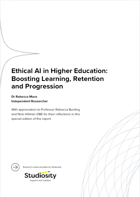
For further findings, download Dr Mace's multi-institutional, independent research on Ethical AI in Higher Education: Boosting Learning, Retention and Progression - here.
References
- Al-Mughairi H, Bhaskar P (2024) Exploring the factors affecting the affecting the adoption AI techniques in higher education: insights from teachers’ perspectives on ChatGPT. Journal of Research in Innovative Teaching & Learning. https://doi.org/10.1108/JRIT-09-2023-0129
- Ma ZF, Hill A (2024) Four steps for integrating generative AI in learning and teaching. Times Higher Education (THE) Campus. https://www.timeshighereducation.com/campus/four-steps-integrating-generative-ai-learning-and-teaching